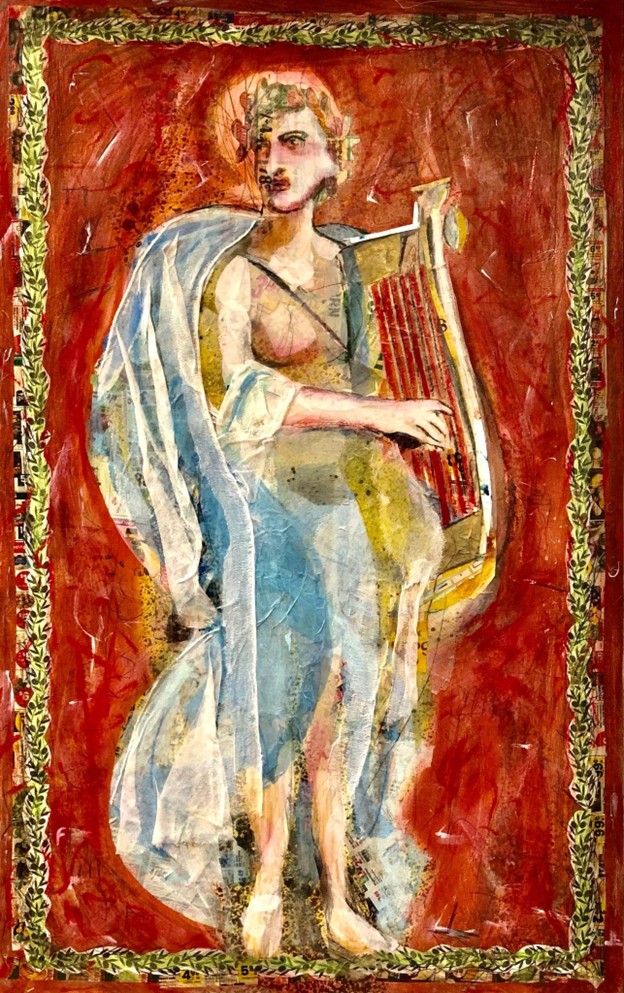
Psychotic Reaction: The Death of Pentheus
Amos and I Unmake the World
Marin County California, Thursday October 30, 2025
Dear Amos,
How do I hear your familiar, faraway music even still? You have percolated through the minutiae of my everyday mind so that I turn away from the immediate…but toward what, exactly?
Leaning against a live oak here in 2025, I scan the horizon from the seaward flank of Mount Tamalpais. A gust of your old loneliness comes off the ocean and tangles my hair. I squint past the edge of a continent, as if I could calculate an azimuth between you and me. But fog hides the distant pinnacles of the Farallones, where I imagine you still pacing back and forth.
At this point, is yours a celestial body? Or will I turn away from the ocean and see you in the flesh, sitting with your back against a boulder, dropped out of time just in time to meet me here? This confounding realm of questions draws me to you as inevitably as tides to the moon, and maybe that’s it: Like gravity, your field of influence is palpable, but when I try to explain how it works, I flail, lost somewhere between my physical mass and your persistent energy. I turn landward and the hundred and thirty-two years since you died keeps collapsing. Here you are, turning and turning in my mind, even still.
Let me try to explain: Years ago, a scientist hired me to walk the shoreline of San Francisco Bay…to count oysters. See me now with my clipboard and rubber boots, in the same wide-brimmed hat I’m wearing today. See my bemused expression to find myself — a lifelong beachcomber — getting paid to survey the intertidal zone. And as I wander the salt pans and cobble I’m also gleaning stories. At Eden Landing, I spy Ohlone hunters in the long-gone wetlands as hordes of waterfowl darken the sky. In the Presidio, I join an 18th-century crowd wagering bets in five different languages on an organized fight between a Spanish bull and a California grizzly. Essentially, I am doing what I always do: meandering, stitching stories out of the air, living in the meaning those stories create…but I didn’t expect to meet you there.
When oyster season was up, the scientist needed a research assistant, so I spent a few months in libraries reading old expedition journals and cataloging mentions of sea otters, eelgrass, oysters, and bioluminescence. One rainy day at the San Francisco Library’s main branch, in the back of a filing cabinet I found a worn manila folder full of old letters. I opened it. That’s how we met. You reached out through time and took my hand.
In 1849 you came here for the Gold Rush; I was holding your letters home to Mystic, Connecticut. Sitting on the floor under the library’s fluorescent lights, you led me down the dusty streets of Sacramento and the crooked pathway of a life. I read about your bad luck, worse decisions, and finally a journey out past the edge of the continent. I shared your longing, especially, as you remembered Mystic and asked to be remembered by it, while at the same time striding headlong into a new era that swept you inevitably forward.
That day in the library, I looked up in wonder but saw only a crowd of people wearing headphones and intent on screens. They seemed much further away than you did, Amos. I am someone also caught between worlds — between a palpable past bursting with stories and a lonelier, technological present — and your letters felt personal, riveting. You caught hold of me and I chose to live for a time in your story, and now you pull at me with an invisible force.
Sacramento City, Wednesday Aug 28, 1853
Dear Friend,
I received your letter and you do not know how glad I was. I should have answered sooner but I was up in the “diggins” and I could not write from there so you will have to excuse me and I will try and be more particular in the future. Your letter informed me that Hannah had not received but one letter from me. I have written 3 letters to her and have received 2 from her. You must tell Hannah to excuse me for not writing to her in particular this time, for I shall try to write to her next time — and let her read this letter with you and tell her I have not forgotten her by any means. Please write to me every chance you have and give me all the news there is in Mystic…for I don’t expect to see you very soon perhaps never.
I suppose you would like to know what is going on in California and I will give you what information I can. The Mystic boys are all well and some of them are doing very well indeed…working in the mines is uncertain business as some are lucky and do very well while other poor devils work just as hard and don’t make 2 dollars a day. I expect you have had first-rate times at home this summer and I should like to be there with you but I must content myself to stay here until next summer and then if nothing happens I expect to see some of my old friends again, especially the girls. I don’t take much comfort here I can tell you. There is but one young lady here that I know and I know her only by sight for I never spoke to her in my life and that is not the worst of it for I never expect to and you know very well that I do not enjoy myself very well unless I am in company with the girls. But if I should live to come home I mean to have a good time and I rather think that I shall not go to California again.
Your sincere friend
Amos
Dear Amos,
Slow down! Men in dusty boots bump my shoulders and the racket rattles my bones. Amos, wait for me. You are so young. You’re 19, striding along chuckling to yourself, you’re harder to track than a run-on sentence. The dust-plumed distance swallows you before I can catch up.
San Francisco January 9, 1857
Dear Father,
Since my last letter to you the great contest for President has been decided the old year has passed away and 1857 has commenced his course. In the way of news I hardly know what to write as I have done but very little since I wrote you last. The schooner has been sold and consequently I am again out of employment but I am in hopes for a short time only. Lod Sawyer and myself have rented a small sleeping room until we can get into some kind of business again. I am at present trying to get the appointment of Light Keeper at Fort Point as the present Keeper talks of resigning in a few days and I am in hopes he can be induced to resign in my favor. John Wolf [light keeper at Point Bonita] has been to see him for me and Lod Sawyer is doing what he can for me in the Custom House. If instead of going to the mines last winter I had staid here I think it very probable I should now be holding a good situation at the Custom House…but I went to the mines and so of course lost all chance at that time since my gold, papers and prospects were stolen in the mines, including a letter of recommendation. If I could get a letter from some prominent man at home to recommend me, I should be all right. Father, I hope you will think this business of enough importance to assist me all you can.
As regards my capabilities, there are but very few jobs here I am capable of filling. I am not very ambitious and would be glad to get a situation as “Messenger.”
Believe me
Your affectionate son,
Amos
Dear Amos,
See, here’s what happens when I read you: We stand together on Battery Street outside the San Francisco Custom House, people going up and coming down the steps behind us. We’re not too far from the library where I found you. And in that same library, I looked up the newspapers from the day you wrote this letter. We can do that in 2025.
Turns out a big earthquake rumbled through the city that morning — this morning — January 9, 1857. Did you feel it? You live at the chaotic edge of the world, as chaotic as your mind appears to be, influenced by forces you might imagine but can’t understand the way I do: That the Pacific tectonic plate slides under the North American continent. Deep below where we stand, rips in the earth’s fabric rub against each other, languorously making and unmaking the world.
Have the soirees and girls of Mystic faded? What schooner were you talking about? Why have four years passed since your first letter? I try to ask my questions, but you’re already looking up at the Custom House. You may not be ambitious, as you say, but you need to hustle, so I’ll let you get to it. I step aside and you take the steps two at a time. My gaze lingers, and the truth is I am not so ambitious either.
I wanted to tell you: I don’t walk the shoreline anymore. I got serious, had a baby. I barely hear that old hum of stories above me; it seems to have drifted away. San Francisco Bay and its cities have shape-shifted, just like when you were here. New speculations roll through. Not gold this time, but ethereal industries of technology and desire, with their attendant money sweeping through neighborhoods, changing the landscape.
2025 hustles catastrophe faster than I can keep up. Often, I slide backwards and panic. Now I work as a writer for hire, spinning stories for whoever will pay, and my stories exist only in the ether, coming and going with monetary transactions. I’ve lost my place in this shifting world of binary code and planned obsolescence. Less and less is heart-felt, and I hesitate to even reminisce about that part of my life lived before it got this way. Can we find Mystic again?
I’d rather stay with you than go back to my job, so I call the historical society in Connecticut. Just think of it as a kind of Morse code telegraph, but instead of signals going through wired electricity, I talk into a device that converts my voice to electrical pulses, which are transmitted across radio waves. We have transmitters everywhere to relay the waves, including in space. What took you five weeks to tell your father takes me only a few milliseconds. It’s true, but it’s tenuous, and loud. We live in a constant electrical storm of words. When someone finally answers, I say your name.
Point Bonita, March 8 1857
My dear Brother,
In the first place I may as well explain where I am, what I am doing, &c. I am at present Light Keeper “protem” at Point Bonita (at the entrance to the harbor of San Francisco) in the place of John Wolf who is sick. I have been here since the 3rd February, but do not expect to stop here more than perhaps a fortnight longer as Wolf will probably be able to attend to his duties by that time.
Now for your letter and it is with both pleasure and grief that I write as you will observe in the sequel. It perhaps might be considered as somewhat remarkable (and it certainly seems so to me) that two brothers separated such a vast distance one on the broad Atlantic the other on the placid Pacific not having seen each other for seven long weary years, should be thinking of the same subject and at the same time too but I can assure you my dear brother, although I have not mentioned it in my letters that there has been one subject on my mind for the past two months which I have thought of more than anything else and that was the very subject which composed the principal portion of your letter to me: “the great West.”
I have thought much about it and have also spoke of it to several of my acquaintances and if my circumstances were satisfactory to myself I would make the West my permanent home. But as it is not my good fortune to be so circumstanced I must endeavor to console my self with the hope that by and by my situation may be more flattering.
I am very glad to see by your letter that your mind is turned in that direction too for it is my firm and honest belief that any sober, honest, and industrious young man…can with proper diligence and perseverance attain a competency and may be able in his old age to live comfortably and to look back with pride on the path marked out by himself in his setting out in life.
I hope however you will think the matter over seriously and not be in too much of a hurry. (as I see by your letter you are very ardent in the cause) for you are young yet (17) and I fear rather too young to start out into the world alone with no more experience than Mystic affords. I hope you and Edmund will be content to stay at home a while longer and help Father for he is getting old and is not so strong as he once was. Do not flatter yourself with the idea of going out into the world and being your own man for depend upon it you will rue the day unless you are old enough to be well versed in the duties of life and have some fixed plan marked out for the future.
Perhaps in a year or so I may be able to assist you…but as you are aware I got nothing for my labor last spring and summer and business was never so dull in California as at present. I hope however that my present undertaking will amount to something and I have very fair prospects thus far that it will. Mr Latham says that when the New Collector is sent out by the President he will give me a letter of recommendation and will use his influence to get me a position in the Custom House. Write on receipt of this and by every opportunity and believe me as ever
Your affectionate brother
Amos
Dear Amos,
Do you have some fixed plan marked out for your future? I wish I did, because at present I’d much rather stay with you. The historian in Mystic uses email to send me some of your family papers. (It’s like the telephone only there are calculating machines that translate her written message into electro-magnetic binary codes and communicate with other calculating machines to send the message to me.) Out of this nebula of missives and signals comes…your very own granddaughter! Bear with me, Amos. In the 1980s she wrote a family history, and you’re in it. But I’m afraid the dates don’t line up. You never got to meet her.
She says you were 18 when you left for California and in love with Hannah Morse, a Mystic girl. Your father gave you the money to go west, but you’ll have to earn your way back on your own. You started working the diggings with another man who’d been there longer, and unlike a lot of the other men, you found gold! But one morning you awoke to find your partner gone, and the gold with him. All you had left was the very first nugget you’d found, which you later had made into a ring in the shape of a snake with a tiny ruby for its eye. Ouroboros of course. Because you must reinvent yourself again and again using only the energy and audacity you can find within. The West, indeed.
San Francisco April 5 1857
Dear Brother,
I received your letter of March 2nd and the 29th and you can have no idea of my surprise on learning that Father had gone to Washington and when I read the particulars to Lod you can have no idea how pleased he was for we never dreamed such a thing and for myself I can only say that I shall never forget the obligations I am under to my old teacher Mr. Potter who so flatteringly recommended me as a young man possessing “natural talent of a high order.” I owe a debt of gratitude that I shall never be able to repay and I wish you to see him as soon as convenient and say to him that from the bottom of my heart I thank him for his kind efforts on my behalf and I wish you to send the addresses of each of the other gentlemen who signed the document. I hope to be able before many months to write to you that we are occupying good positions. But time will tell and as “disappointment is the lot of man” we will not be too sanguine of success, but hope for the best.
I am
Your affectionate brother
Amos
PS (April 6th) I write this in great haste. Everything thus far goes swimmingly. I have just come from the Custom House. I went up to see Mr Latham and he told me that I should have the first vacancy and perhaps I shall get something before long.
San Francisco April 18 1857
Dear Father,
Your very sorrowful letter of March 18th was received by due course of mail and I hardly know what to write or how to answer it for it was of such a nature that I am overpowered with grief and sorrow. When I received the last letter from Horace everything at home was all right but now in the short space of two weeks how changed. My poor dear sister at the early age of twenty-one left a widow with a dear child so young as to be unable to realize her loss and I have lost a dear brother.
I do not desire nor do I feel like writing much at this time for the sorrowful tidings have so overpowered me that I am not in a condition to write or hardly think.
Give my best love to all our family and believe me as ever
Your sorrowful but affectionate son
Amos
PS I will write you a line about the affairs of Lodowick and myself. We are using our utmost endeavors to get all the influence possible in this country. One of Lod’s friends who has been one of the principal clerks in the Custom House for the last four years…has promised him that he will write to his cousin this mail and recommend Lod to him, so I think if all works well we may be successful in getting a place.
Amos,
There you are in a small, cold room, staring at the wall. I can feel a familiar whiplash of hope and despair swirling in the air. I don’t dare approach you; I just put a log in the stove and stir up the embers. On the table is a scribbled letter to Mystic. Will it arrive? Does Mystic even exist, or were your letters only ever destined for me? You are 144 years older than me, but I am just 16 years older than you are to me right now. We’ve collapsed time, you and me. We are two particles hurtling toward each other at the speed of loneliness and inexplicable desire.
It took me less than an hour to find out the widow is your sister Lydia, and the deceased was her husband, William Stanton Williams, of Stonington, Connecticut. He died on March 16, 1857, from inflammation of the lungs. (I also found out that your pal Lod Sawyer will one day patent a design for a new kind of curtain rod and get rich. Can you believe that?)
I live in a time when I don’t have to wait much for anything. Our technologies multiply and multiply. Built on speculation, just like your gold rush. Built on desire — for information, convenience, money. At least your gold is solid. Ours is a speculation of zeroes and ones. We devour them and build our lives around their ethereal framework. Our reward is consumption in a dizzying variety of modes. Supposedly this is a good thing, but I don’t know. It all seems to be coming to such sorrow.
San Francisco May 1 1857
My dear Brother,
I do not feel much like writing as I have got a very lame neck. Lod and I went swimming a few nights ago and I caught a severe cold and have had a stiff neck ever since but am getting better now.
Give my love to all the family
Your affectionate brother, Amos
Dear Amos,
Lod sleeps on his cot near the stove. You knead your shoulder and flex, cringing. There’s so much noise from the street: laughter, shouts, crashes cutting through the fog. From across the table, we smile at each other. I can see Mystic’s last shadow fading in your eyes, and that you know it’s a figment while also longing for more of its dream.
On the other hand, California was made for night swimming. Accompanied at the very least by friends, usually done on a whim from the warmth of a driftwood fire, out under a sky full of whirling stars, and most definitely aided by whiskey…night swimming, awash in bioluminescence, you are wide awake and at the height of your senses. I know, because I’m a night swimmer too, or at least I once was. Right now, you are hungry for the future and I can almost feel it too.
San Francisco Aug 2 1857
My dear Brother
In as few words as possible, I will try and explain matters in regard to Miss Hannah Morse. When I left home in ’49 I considered myself in every sense of the word “engaged” to her, and I know that she and her parents were of the same opinion. We corresponded with each other regularly for some years until Mr Fish made his appearance and after a while she wrote to me stating that she had dismissed him, and requested me to write to her as before. I did so and matters went on smoothly for a while but you know the old proverb, The course of true love never runs smooth and after a while Mr Fish made another “desperate effort” and offered her “his hand and heart.” Mr Morse however, mistrusting his intentions (and I shall ever esteem him highly) politely requested the young gentleman to leave his house, and never enter it again on that kind of business. The result was a row and Mr F left the premises with “a heart too full for utterance,” i.e. slightly excited, and I guess he has never visited there since that time. (I shall always believe until I have proof to the contrary that my letters to her were tampered with, at the time he was a clerk in the Post Office, and if I ever meet him, we shall probably have some words at least on the subject.)
She then wrote to me and told me everything that had transpired and we continued to write to each other until I left here in the schooner “Heloise.” (as I supposed for home) on May 1854, I went from here to Valparaiso, from there to Tahiti, where I stayed 5 or 6 months and finally got back to California again. I went back to Tahiti again and arrived here in August 1855. I received a letter from her written “May 1st 1855” stating that she had given up seeing me again and suggesting that we should close our correspondence. I answered her letter and have never written to her since, until last mail (July 20) I have understood that she does not go much into company and that her health does not appear to be so good as formerly and I have thought that perhaps she would write to me if I would write first. Consequently I wrote to her by the last mail and a few weeks will probably tell the result. The above is in brief a correct statement, and I trust no one will know it but you and me.
Write often as you can for you don’t know how acceptable your letters are
Give my love to all the family and believe me
As ever your affectionate brother
Amos Clift
Dear Amos,
Mr. Fish, notorious rascal of the Mystic PO? Hannah Morse, in her eighth year of correspondence-or-not? How is she still maybe available after all these years? And the Heloise. The mysterious schooner from early in your letters, coming back around on the wheel of stories.
You were in Tahiti during the gap in letters. But how does one think one is going home to Mystic on a voyage to the South Pacific? I’m scanning back through everything I know about you. You came from a carpentering family. Your father built boats and houses in Mystic, which still stand as museums and landmarks. I am searching for the Heloise’s crew and passenger lists, but until I find them, I’ll think of you as the ship’s carpenter. Lord knows you didn’t have money to buy a fare. But not a word of the voyage itself, and not a word of what you did in Tahiti for all that time.
How much of a person remains in his written words, if that’s all that’s left of him? You are lonely, perhaps editing the truth into a version fit for your imagined Mystic. No months recounted lolling on the beach, gambling for black pearls with sunburnt sailors in a thatch saloon. Dwelling among tattooed men whose ancestors ranged the ocean in voyaging canoes, ancient journeys no Mystic sailor could envision, or could he? One of them tried to teach you wayfinding, but you were too drunk to remember what he showed you. I wish I could’ve seen you there, Amos. We’d stumble together under those incomprehensible stars.
The woman at the historical society claims she has no other letters from you in her collections. I am turning in circles, trying to navigate between so much information online and these beautiful missing pieces. You are spinning your wheels too, with your Custom House vying. Across a century and a half, more than anything I want you to land your precious position, and find my own here in 2025, where my world is listing badly in an unending storm of changing technologies, each one pushing me farther from the coast of everything I once loved. So we go on searching and scrambling. For money, success, or simply to make it home alive.
San Francisco January 4 1858
My dear Brother
It is now quite a long time since I wrote you last and the only reasons I have to offer are these: viz. I had nothing to write. I have failed at getting a position at the Custom House and am going to try another speculation.
Believe me
as ever
Your affectionate brother
Amos
San Francisco February 19th 1858
Brother Horace
There have been times when I have not written for quite a lengthy period, but the reason was that I felt so low spirited and discouraged that it was impossible for me to write.
You mentioned in one of your letters that it was reported that I was dissipated. I should like very much to know where the report came from.
I have drank some liquor in California and if I live I expect to drink some more but, that I am, or every have been, dissipated I utterly and unqualifiedly deny, and I challenge the party who makes the assertion to bring out the proofs. Ever since I left home it seems that there has been a settled plan to injure me for some purpose or other at first it was reported that I was going to marry a Spanish Maiden and as it is generally understood at home that Spanish girls are whores (I shall endeavor to use plain English) the news must have been very refreshing.
But
“Who shames a scribbler
“Break one cobweb through
“He weaves the slight, self-pleasing task anew
“Admire his wit or sophistry in vain
“The creature’s at his dirty work again.”
Now they harp on dissipation. Well I cannot help it and care nothing about it so far as I myself am concerned. But the thoughts of my parents and friends at home is what gives me pain and many a bitter lonely hour have I passed in thinking of these things. I remain as ever
Your affectionate brother
Amos
Dear Amos,
Such panic, such speed. From where I sit across from you in that cold little room, your pencil digs impressions through the paper and into the soft wood of your table. Look how Mystic raises its fair head. You are losing hope. But (mis)quoting Pope is sheer perfection. You could not have offered a better seduction. Your frustration draws me like a magnet and also your earnest, terrible loneliness. How is it that I know you as kindred spirit? Across all this time, yours are the words that enliven my flagging heart. Out of place, struggling to be understood and to thrive. We are the same, you and me. On a whim I lean forward, reach for your face and pull you toward me. Our particles collide with 167 years’ worth of the sun’s energy. The cloying taste of brandy on your lips goes to my head while behind me, liquor drips down the wall and lands in the shards of the bottle you just threw.
San Francisco July 141858
Dear Father
I received yours of June 19 this morning and I can assure you that it was perused with much pleasure. I have been in town about two weeks having come in for the purpose of handing in the Yearly & Quarterly returns of the [Farallon] Lighthouse where I now reside and work, and also to spend the Fourth.
I cannot answer your letter in full at this time for I am expecting to go back out to the Lighthouse today or tomorrow on one of the Pilot boats and I will write you from the Island and give you a full account of the Light and everything appertaining to it.
Give my love to all the family and particularly to little Lydia. O how I should like to see you all but that is impossible.
In great haste
Your affectionate son
Amos
Amos!
You left me worried in that small room, and now everything has changed. After all these years you’ve gotten a position? I wanted a celebratory declaration. I wanted you to swing me around, laughing your hot breath onto my cheek. Oysters and ale and your tiny room…but that’s not how life works, is it? Careening into the next thing, the next century, the next self, forgetting the agonized tedium that came before. Running toward new agony. I do it too.
The Farallon Islands are twenty-seven miles offshore. That is very, very far away from people. I know you. You are happiest in the company of friends, where your reflection through someone else’s eyes is never far away. You are always in such a rush. Well, the islands will change that. Amos, wait! You’re getting blurry and I’ve got a bad feeling about this.
Farallones Light House Aug 15 1858
Dear Brother Horace
We have been having beautiful weather (for the Farallones) for several days past and Mr Maynard (1st Asst) and I have been making us a little skiff to pull aboard of the fishing boats that come here to get our letters &c We are considerably bothered about getting news here as it is very difficult to land. The Island as you are perhaps aware is a high rugged and barren mass of rocks in the open ocean. There has never been any regular communication with the city except by the boat which brings out our provisions once in 3 months and the reason has been that the late keeper in the first place could hardly write an intelligible letter.
My eyes have not got well yet but they are much better and I hope they will not plague me much longer. I am inclined to believe it is caused partially if not wholly from an impure state of the blood. I am now taking some syrup for my blood (which I know is impure) and also using Thompson’s Eye Water. I expect one great reason why yours are so much inflamed is looking at the “female form divine” I presume my eyes would be worse than they are now if I could be at home this winter and go to a few parties.
But seriously, Horace, you must be careful of your eyes and not let yourself read much and none at all by candlelight for that is one of the very worst things for weak eyes.
Give my love to all the family and particularly to little Lydia and believe me as ever
Your affectionate brother
Amos
Dear Amos,
We sit on blocks in the half-finished skiff. Sap pearls from the newly hewn wood. I was right: carpentry is in your blood. You’re making this boat without even thinking about it. You talk a mile a minute about the need for a larger boat, about the lack of a safe harbor here, which you regard as not insurmountable. You fidget, tearing up wood shavings and letting the wind take the pieces, never letting your red-rimmed eyes settle for more than a few seconds. I zip up my jacket. Your wool coat’s unbuttoned. Waves roar against the slick black cliffs and gulls scream. This place is wild, Amos. Wilder than you will admit.
You shiver and climb out of the skiff. The man I see, pausing with his lathe, looking across a terrifying stretch of sea that separates you from everyone else, is silent now and considering what, exactly, he’s conjured by accepting this position. When I went to the Farallones a few years ago, a guide on the tour boat told us this place is a refuge for great white sharks, that they come from hundreds, even thousands of miles away to circle these rock pillars far below the surface, continuing their kind’s ancient circumnavigations of the planet.
I wish I could stay with you, Amos. I wish I could bring you with me. But you’ve got to do this next part alone.
Farallones December 16 1858
Dear Brother,
I intended to have written to you by the last mail but the weather was so stormy that no boats could come out here for about ten days.
I have nothing under the sun to write you in the way of news so you must excuse a brief epistle. I expect to go to town sometime next month and shall try to send some money to Father.
Give my love to Grandmother and all the family and tell little Lydia that she is not forgotten.
Your affectionate brother, Amos
December 28 1858
Horace,
It has been very bad weather for some days past and no boats have dared venture out from town. I shall finish this and send it by the very first chance and as today is very pleasant I expect some boats here tonight.
I should like to be at home this winter to enjoy some of your parties and sleighrides for I could, I think, take lots of comfort as winter is my favorite season at home but I must content myself where I am a while longer. Well Horace I hardly know what to write to fill up this sheet for if you have any idea or have ever read of a God-forsaken country this is certainly the very spot. Nothing but a barren rocky island, with the continual roar of the surf breaking on the rocks. That is the only sound to be heard. I don’t know but I should almost forget my name and genealogy and nothing but the prospect of getting home again would ever induce me to stay in such an isolated & gloomy place.
Believe me as ever
Your affectionate brother
Amos
Dear Amos,
Even when you’re being swept away from everything you ever knew, you are not lost because I’ve got hold of you. I know your name and genealogy, and I will not forget them: Your brother Horace becomes a Deacon with the church. Your sister Lydia marries again, a man named Samuel J. Lee. I know your brother Edmund and your sisters Sarah and Seneca. I even know about Lemuel and Edwin, may their little bones rest in peace. And how about this to keep you going? You become a Lieutenant. Yes, you! In the 1st Connecticut Cavalry, under General Ambrose Burnside. During the war, someone shoots you through the left arm, but you refuse to let the medics amputate it, and it turns out okay. You live through the war, and you have children, lots of them: William, Ada, Katherine, Annie, and Leonard. Does this help, Amos? That I can keep your story safe, that it is what I was born to do? That living in your story also makes me feel alive?
Farallones June 28th 1859
Dear Father,
I received two mails since your last letter and I was glad to get it. Letters from home are very welcome on this lone barren rock. Mr Maynard, 1st Asst keeper leaves here tomorrow for town to go home by the next steamer (5th July) and I feel as if I was losing a brother. There is nothing of interest here to write about.
Your affectionate son
Amos
Amos,
I stand inside the light keepers’ cabin, watching your retreating back. I want to run to you but something holds me at the window. With your collar upturned against the salt spray and the ever-present wind, you hunch along with your head down, under a thick overcast. I get the sense you’re talking to yourself. Who wouldn’t, in your position? You do not stumble on the rocks or tufts of wild grass. In a sudden move you raise a rifle – I hadn’t seen that – and shoot a seabird off the nesting cliff. You keep walking. Adrenaline shoots through my body. You don’t even see the bird fall, wings outstretched and then crumpling on the ground. You shoot another one out of the air. And then another. And another. Now thousands of birds swirl and scream above you. You shoot and shoot. Shocked, I cover my mouth with my hand. The island’s 2nd and 3rd assistant light keepers come out from the kitchen and stand beside me at the window, shaking their heads. Mr. Maynard is gone, and with him the last reflection of yourself as a respectable man. Your purpose, whether real or speculative, no longer matters. You are undone.
South Farallones Nov 30 1859
Dear Brother Horace,
I tell you I am getting awful tired of this loneliness. I am in hopes that Govt will make some arrangements to have a vessel visit us regularly I am trying hard for it and have written one or two “official” letters on the subject. Things at this Island have always been in an unsettled state.
Write me as often as you can for letters are all that keep me alive here and it is now more than a month since I received any.
Your affectionate brother
Amos
South Farallones February 27 1860
My dear Brother
Yesterday was a glorious day on the Farallones, and the happiest Sunday I have passed for many a day. About noon a boat came in from town and we received some two or three overdue mails and my afternoon was passed away very pleasantly reading my letters.
I had been fretting for some time because I got no letters and had written to Lod a number of times about it, but at last they came all in a heap and consequently my fretting is over at least for the present.
I see that Mother thinks I had better “come home and get married” does she, well I am exactly of the same opinion, but, in regard to “starting anew” we differ for I have had such bitter experience in the past that I dare not trust the future and if I were now to start anew, I fear my head would be “silvered o’er with age” (as it nearly is already) before I got fairly under weigh. If my circumstances would permit I should try to follow her advice but when I left home I made up my mind that I should never see it again unless in different circumstances I am of the same opinion today. It is not a very pleasing reflection but it has been my thought through ten long years. I have seen much sorrow during that time much more than I ever expect to get paid for and have of course got somewhat weaned from home but yet I long to see it again for there are those there who are near and dear to me but as for Mystic itself I cannot in truth say that it has any charms for me and I do not now think I could be contented there. All those I have ever seen who have been there and came back again say that, after living in California a few years Mystic is a poor place for them, and they cannot content themselves there.
Has that feather bed which I sent ever reached home? You have never mentioned it and I don’t now as it has ever arrived. It is not of much value and I sent it merely as a specimen of “Farallones goose-feathers” which I collected myself.
Give my love to all the family and write to me as often as you can and believe me
Yours truly, Amos
Farallones June 14 1860
Dear Brother Horace,
I am glad very glad to learn that you are going to stick to the “old familiar spot” and I certainly think Horace you have come to a wise conclusion and I believe today that I should be far better off and happier if I had never left home but this far in life my lot has been cast in slippery places and I am getting too old now to think of starting anew therefore I must abide the issue. “There is a Divinity which shapes our ends; Rough hew them as we may.”
At present I have about made up my mind to remain in California that is if I can make satisfactory arrangements, for as I view the matter it would be perfect folly for me to go home unless I had money sufficient to enter into some business and as I have not I must try and content myself here. I have written to Hannah asking her if she will come out here if I will send for her and upon her answer my future course in great measure depends.
But I must close as we have some visitors here stopping a few days and I must “do the amiable” as well as possible. Write as often as you can find time and believe me as ever
Yours truly,
Amos
P.S. I hope you will excuse this short letter, Horace but the fact is I am very busy at present. I am studying to accomplish a certain end and you must know, I am very much occupied.
Dear Amos,
We sit across from each other in the skiff bobbing near the rocks. Your coat is over my shoulders, and for once it’s me that can’t stop talking. You are “studying to accomplish a certain end.” This is your last letter, so this is my last real look at you. You’ve rolled up your sleeves and your arms rest comfortably on the oars. We’re bobbing in the narrow strait between islands, and I am desperate to stay with you. But each of us studies that certain end, the only certain end for all humans. Not to get too philosophical, Amos, but isn’t that study our lives themselves?
For a long time, physicists built a unified theory of the universe, Amos, because we all want to live inside a sturdy framework of meaning. Writers like me do too. Despite our lots being cast in slippery places, we look for patterns, we work toward ideas of success, we try to create order. But all of a sudden, after scientists built the particle collider and it turned out to work, a different picture emerged. Maybe, instead of an elegant, logical system, our universe and everything we know about galaxies, stars, dark matter, and the fabric of reality where we all supposedly reside was created out of nothing more than a few coincidences. Like how I found you. Maybe all of this — I gesture to the overcast sky, the choppy sea, the islands — is the greatest meaning we can seek, and imagination creates the only coherent moment in a profoundly chaotic universe. You are part of me. Your story feels more real to me than half of what I see in 2025. What more meaning do we need? I pause for breath. You are looking at me strangely. “I think it’s time for you to go,” you say.
You hold the boat steady against the guano-spattered island, where men have carved small steps into the rock. I scramble out. We look at each other as the boat drifts away, and then, as if it’s the most natural thing in the world, you row leisurely out into open water.
Eventually, you were fired from your position at the Farallon Light House. The reason, my online research reveals, was for making a deal with the egg company that came out every summer to illegally harvest seabird eggs to sell in San Francisco, where there was a chicken egg shortage. You got a cut of the profits and then lost your job. But with the money, you returned to Mystic. And when you got there, you married Hannah Morse.
After you fought for the Union army, you lived in Washington DC as a guard of that city. Hannah and the children were there for a while, but eventually she moved back to Mystic. Why, Amos? I imagine you went back and forth for a time. But then you returned to DC for good, to work in the Pension Department. Because you were always restless for new stories, like me. That curiosity and wanderlust won’t let us rest. You lived alone in a boarding house, occupied by pursuing that certain end until you caught up with it on December 24, 1887.
No one claimed your body, and when a friend finally inquired, the hospital sent him to a potter’s field, but your remains weren’t there. Turns out you were in a dissecting room at Georgetown Medical College. Members of the army under the supervision of your friend took possession of your earthly remains and finally buried you at Arlington Cemetery. That friend, it turns out, was none other than the rascal of the Mystic PO: Mr. Fish.
I leave my desk and walk outside, back into 2025, blinking in the impassive California sun. Up the street, my neighbor’s gardening. People ride past on bicycles, and a PG&E worker removes an obsolete telephone wire from between two poles. It’s time to pick my daughter up from school.
Somewhere in your faraway music, out among the Farallones, we’re still sitting face to face in that little skiff, bobbing on dark water. But what I’ve learned from you is that all we can do is change and keep changing, reinventing ourselves through time as we pursue that certain end. Stories continue on and remain. We’re together there, pulled through time like tides to the everlasting moon. All at once, it fits again, this life. Thanks to you.
Believe me as ever,
your affectionate and eternal friend,
Stacy
*Note: Amos and I Unmake the World” is a hybrid creative nonfiction/fabulist work. For clarity, this piece includes real-life letters written by Amos Clift between 1853 and 1865, and my contemporary replies. Amos’ letters now reside in the public domain.
The last day of her life
When Sophie sits on her sofa on March 6, 2017, she considers ending her life.
It’s not yet spring in New York City—no flowers or leaves on the trees—but it feels as if everything is ready to bloom after long months of winter stillness. Spring is her favorite season, and she doesn’t remember yet that she always feels like a different person when the pink petals start to fly in the sky and land on the sidewalk, a magical wonder that only lasts until the busy New Yorkers walk on them and strollers squash them, petals sticking to their wheels for blocks.
That morning, she woke up exhausted alone in her bed in her dream home in Brooklyn at the border of Clinton Hill and Bed-Stuy. Her place has two floors, two bedrooms, an office, and a rooftop. She filled the space with West Elm furniture she loves: plush carpets that she likes to step on barefoot, designer white chairs, and a mid-century modern dining table she bought with plans to host dinners. These objects make her feel like she succeeded in life.
Her husband, Guy, had just left to drop off their two-year-old, Capucine, at daycare before heading to his accounting job in Manhattan. Still in her pajamas, Sophie shuffles down the stairs to the living room, grimacing at the feeling of the heavy, wet pad sticking to her crotch. She feels dirty. She walks faster past a mirror, avoiding her reflection, and settles into her usual spot on the beige-gray IKEA sectional sofa.
This is where she is when she realizes she cannot continue with her life.
She has had some glimpses of him in the past. A year before, she looked more closely at her face in the bathroom mirror in their smaller railroad apartment in East Williamsburg, but did not recognize herself. She felt disgust, thinking she looked like the man with a rat-tail haircut in The Walking Dead, which she religiously watched every week.
Before that, while visiting family in Melbourne, Australia, she had walked around the hot, buzzing city, wearing a red summer dress and a huge polka-dot hat, pushing her baby in a blue Yoyo stroller. It was so damn hot, and her thick hair made her even hotter. Trump had just been elected for the first time, and her anger bubbled up like lava. So, she turned into a nearby salon, sat down in the 1950s red-leather hairstylist’s chair, and found the strength to ask for what she had always wanted but had never allowed herself: a short haircut.
Under the big black cape covering her body, her thighs were sweating in the chair. The hairstylist cut her hair shorter and shorter. Sophie sat motionless the whole time.
She stared at the mirror.
In the mirror.
Typically, she avoided mirrors and only glanced at them briefly. Yet, in this moment, she looked into her own eyes. She stared deeply. They were like black holes swallowing stars.
Suddenly, she saw a glimpse of him again. What was this? Who was this? Who was Sophie, really? She didn’t know it yet, but that day, she would sit down in the hairdresser’s chair as Sophie and stand up as Max.
Here she stays, two months later, on her beige-gray sofa for hours. Stuck. Frozen. Staring into the void.
She can’t take it anymore.
Last night she got her period again. It had returned a year before, after she stopped breastfeeding her baby. That’s how it works. Before that, she didn’t have periods for years while taking birth control. But here it is, in her belly, outside her body, dark red on her fingers when she goes to the bathroom. She feels nauseated and sad, as if her body is not a safe place. Each time her period reappears, she disconnects from herself as she waits for it to pass, already anxious about the following month when it would return. She believes she hates her periods because she is weak and lazy.
On March 6, 2017, she can no longer stand it. The only way to end it is to stop living in this body. To stop living.
She knows she will do it if she leaves the sofa, so she calls her husband at work and whispers, “Please come home. I am about to do something stupid.”
She is still within this crystallized moment, while he makes the forty-five minute train trip from the Lower East Side. It must feel like hours to him. While she waits, she is barely breathing, not looking at anything, hanging by a thread, desperate for help.
Guy was supportive the previous fall when Sophie needed to stop working for three months due to severe burnout, which put her in the hospital for a week. He cared for Capucine so that Sophie could rest. Her brain felt foggy every day, and she struggled to focus. Even browsing the internet felt almost impossible. She realized that, after a month, when she returned to work for her design client, she couldn’t understand what was on her screen, a project she had been working on for a year. Terrified, she had to accept that she needed more time, her brain still healing from overexertion: twelve-hour workdays, caring for Capucine at night, managing the home, and attending to Guy’s needs, even making doctors’ appointments for him. She had too much on her plate. Would she ever be able to go back to work? Her entire career was built on multitasking and working hard. She was scared to admit that something had to change. But what?
Sophie grabs her favorite blanket and covers herself, still not leaving the sofa. Since the burnout, the spot became her place to try to relax. On that sofa, she learned how to breathe fully, to take her time even though it felt challenging to do nothing, not to be productive. Her whole identity was rooted in achievements and meeting the high standards of the family member for whom she worked. She had to look inward and learn to listen to her deeper needs, something she had not learned to do in the first three decades of her life. Most days, she binge-watched TV shows, numbing her anxiety and her sense of inadequacy. She feared that she would never find a job again. She was afraid she was broken. Eventually, she decided to watch The L Word, a show about lesbian women and their dating lives. She had avoided watching it until now, succumbing to her discomfort and apprehension, despite her friends constantly talking about it. She now understood why. Through each episode, something in her grew warmer until she felt the urge to look for lesbian porn. This was new for her. She never watched porn before, even straight porn. The shame she felt for seeking such movies dissipated as she discovered her body, giving herself pleasure. This was new for her too. But then the shame would return and she would keep her new pastime a secret, even as she eagerly awaited the next time.
Watching Game of Thrones, she felt aroused at nude scenes, especially when women had sex. She was only looking at the women. She felt herself getting wetter the longer the scene went on. She wanted to have sex after almost every episode. Guy noticed and often joked, hopeful, “Is it a Game of Thrones night?”
Sophie is silent now, waiting for her husband. She is frozen, with no energy to even get up and get a glass of water. How long will it take for Guy to arrive?
A couple of months ago, she finally understood why she was so drawn to roller derby, a predominantly lesbian sport: she was attracted to women. Up until that point, she never questioned her sexuality, but she couldn’t hide it anymore. She had to tell Guy. They had spent eleven years together and were honest with one another.
“I think I am into women. I feel horny around women, and you know how I feel when there are naked women in Game of Thrones…” Sophie said.
Guy looked at her and smiled.
“That’s fine with me if you want to explore with women!” he said, which surprised Sophie, since they were monogamous and had never discussed opening their relationship.
“Are you sure?” She said, anxious about hurting his feelings and about meeting someone new, particularly a woman.
“Yes, go ahead. It’s better if you explore this than repress it.”
Wow, that went surprisingly well. Maybe too well. A heavy weight was lifted off her chest, but a new anxiety surfaced: she had to find a woman to go on a date. It happened via Tinder. It took Sophie a good hour to set up a profile, writing and editing. This was the most vulnerable she had ever felt, even a little embarrassed. “Pansexual, Queer, Questioning, Woman, Open relationship, Non-monogamous, 5′ 5”, “A little extra” build. In a great, long, loving relationship with my man, while open to finally exploring another part of me, who apparently loves women! Everything is clear and honest between us. I am here to have fun on my own, with new queer friends.” She picked two photos that represented her: one with a polka-dot dress and another, more recent, with her short purple hair. Desperate, she liked almost all the women she saw in the app who said they were lesbians. Very few of them replied, but a petite woman with short black hair from Park Slope agreed to go on a date a few days later. Guy happily agreed to care for Capucine while Sophie was on the date.
It took Sophie a long time to find a proper outfit. She landed on a black t-shirt, black jeans, and a pair of suspenders with hot pink skulls. They met at the cozy Russian bar, Masha and the Bear, in East Williamsburg. Sophie asked surface-level questions. The woman politely answered. The date felt more like a job interview and after thirty minutes, they stood up. Sophie was so nervous and too uncomfortable for anything intimate to happen, even a kiss. She wanted to forget about the whole thing, feeling embarrassed and inadequate.
When Guy finally arrives, she can’t hear most of what he says, but he sits beside her, and that is enough—enough to remove the insistent call to end her life. They sit for an hour on the sofa, and when Sophie finally comes out of her freeze, she finds the courage to seek a therapist. Why now? Does she feel something terrible will happen if she doesn’t talk to one? Perhaps the thought of ending her misery is too comforting. Or maybe she doesn’t want to give up. She keeps gasping for air like she did when she almost drowned at six years old. She can still see her mom running to her from the beach.
She needs to talk about her unexplored sexual orientation at thirty-five. After swiping through multiple therapists on ZocDoc, she finds one who works with LGBTQIA+ patients. She makes an appointment for the next morning, wanting him to see her at her worst. She wants him to see how raw and disgusting she is, her wounds in the open like red and pink meat hanging in the window at the butcher shop. She wants him to see how broken and flawed she is. If she waits longer, her facade will quickly rise again as she pretends to be this happy-go-lucky roller derby cool mom. Growing up in a family that did not value therapy, she has no idea that it will save her more than once in the following seven years. Deep scars that seem healed on the surface will be poked at, squeezed, and cut with a surgeon’s knife, releasing old pus contaminating her mind and body.
That night, alone in the bed she bought when she moved for work with her husband from France to New York City five years before, she feels annoyed that Guy is, again, unable to go to sleep until early morning. She wonders what she has done or not done to make him avoid going to bed with her. She can’t pinpoint when it started, but they also stopped kissing goodbye before he left for work, as they had done when they met eleven years ago.
Lying on her back, she is nervous about seeing this new therapist in the morning. She only met one many years ago for a couple of sessions, which made her feel ashamed because her parents did not believe in therapy. She is glad this one is available on such short notice. What time is her appointment again? 10 am. All right. Capucine would be at the daycare by then, so she could go easily. Where is his office?
Rolling to her left side, she grabs her phone from the bedside shelf and pulls up therapist L’s info on ZocDoc. In his profile picture, he looks kind and happy. She swipes and lands on another selfie, except this one shows him looking like a woman. Weird. How is this possible? She remembers watching the show The Fosters, in which trans actor Elliot Fletcher plays a trans boy. Until that point, she had no clue trans men existed, as she only heard disturbing stories about trans women. Her only awareness is from movies like La Cage aux Folles, a “folle” being a derogatory French word for an effeminate gay man, or the homophobic culture in France that men perpetuate, her dad included, referring to “manly” activities like driving a powerful car as not being “for the fags.” It hasn’t clicked for her yet, even though her entire Instagram feed is now filled with trans men’s accounts, where they show their new chests without breasts. Why this obsession? While watching The L Word, she also encountered a trans character named Max. She remembered thinking, “Wow, this is so empowering for the character! I want to feel this too.” Without her realizing it, the glimmers inside her started to vibrate, ready to shed light when the right time came.
Alone in her bed that night, she feels an electric shock. Why did she pick a trans person as a therapist? In these few seconds of realization, she is at the edge of a crevasse, the wind pushing her back while she looks down into the void. Every sign is pointing in the same direction. If she weren’t in shock, she would laugh at the situation. How could she have missed something this obvious?
Alone in her bed that last night, just a few hours after she was ready to end her life, Sophie closes her eyes for the last time, her breath slowing, her blood so cold that she feels her body sinking into the mattress, unable to see the light again.
***
“Fuck, I’m trans,” I say out loud.
My blood warms, my veins revive like tree roots bringing water and sap to the dried branches after winter. I open my eyes and take the first breath of my new life.
Codas
Mary and Mary and Salome
encountered a young man
who told them he was alive
but they were scared
and didn't tell anyone.

Or they came and told
Peter and the rest of us.
Or maybe he appeared
only to Mary Magdalene,
still smelling of sweet perfume
and she came and told all of us
as we were mourning,
trying to make sense
of a huge new absence
at the center of our lives.

Accounts vary.

If she came, we didn't believe her.
We had seen him die.
We know what death is.

Of course, if the three women
just ran away, scared,
then how do I know all of this?
Where do I even find the voice
to tell you this story?
My syllables are just a scribbler's
cynical trick, a metafiction.

So he must have come to us
when we were eating, scolding us
because we know what death is.
He said some hard words.
Those who keep believing
in death will be condemned.
Those who don't can drink
poison and play with snakes.
He said we would speak
in strange tongues.

Luke remembers it differently.
He showed us his hands and feet.
He ate fish with us.
Luke recalls soft talk of forgiveness,
raised hands, blessings.

But I remember something harder
and stranger-judgment
and an otherworldliness in his eyes.

I don't even remember the trip to Bethany
though Luke swears we walked.
I just remember that he was gone again.

But somehow this second loss,
this absence after impossible presence,
was different, compelling us to go,
to tell people, to shape words
that helped others stop,
stand up straight,
and lay their sicknesses aside.
Stone Believer: Portrait of Adonis with Crimson Anemone
Return to Ithaka