Fiction
The Shape of You
In our year of iPhone 16, Vinny feels his phone pulsing in the back pocket of his shorts the second he squats in front of his golf ball and examines the green. He knows of the green’s subtle deception, how it appears as a simple straight shot. It won’t fool him this time. Above, heavy clouds hang still in the sunset like fiery leviathans. He shrugs the pressure off his delicate shoulders and raises his hat to wipe the sweat from his hollow haggard face. There’s time for another workout if he finishes quickly, if he ignores the constant throb of pain in his muscles.
It’s his father who’s calling him. He stands and places his putter behind the ball when his phone stops. From a distance, maybe all the way back at the tee box, his spindly limbs are another set of golf clubs sticking out of his shorts and shirt. He is a scarecrow on the golf course. His shadow slants and stretches behind him, almost reaching the sand-trap, expanding twice his height, a long insect flattened by one of the clouds. Yes, he will stop at the gym before it closes.
The hole of the green peers back at him. His putter taps the ball so lightly he barely feels the shot. He follows the ball’s slow arc toward the hole. His phone vibrates again. The ball lands in the hole with a satisfying clatter.
At the gym, Vinny flexes his triceps in the mirror and takes a picture of himself with his phone. He zooms in on his arms and shoulders, deletes the photo, and takes another one flexing harder. Studying the image, he concludes he feels nothing like forty, and he looks younger than thirty, as if he’s reversed ageing. His face hides behind the phone in his hands. He opens an app and uploads the image to a post and types about his third visit to the gym. Earlier, he posted a picture of the sunset on the golf course. He refreshes to check the likes and finds his father has commented on the sunset.
Beautifall sunset! Lets get out there soon. Love you son.
It’s the only comment on the post. Embarrassed, Vinny scrolls and skims down the unending main thread of media. Pictures pop up with every scroll. Videos play and replay without his consent. Continuous loops of men and women demonstrate proper form, offer workout tips, share advice on health and fitness. They speak casually and confidently, and they treat their followers like friends, it’s all about feeling good and being active, it’s about connection, community, goals, the best version of you. They are exquisite and profound, their bodies sculpted to perfect beauty. Beautiful, impossibly beautiful.
Vinny works as a trainer for the gym, too, but his supervisor has “noticed things” about him that were “concerning” to her. She suggested he take some time off, with pay, while she covered his classes and personal sessions. Time off from anything fills Vinny with dread. He struggles to sit still. He fails to loosen up and let go. He can’t just do nothing. It feels so blank to him.
After a while of scrolling, his mind, so filled with tips on exercise and reels of perfection, aches and swells, his thoughts weighted down with a fresh new bulk of content. He places a dumbbell behind his neck and raises the weight over his head twelve times. After two sets, his muscles burn so much he can barely move his arms. It feels good to him. He looks better now. Before leaving the gym, he takes another picture in the mirror, applies a filter, and uploads a new photo.
He finds two new text messages when he steps out of the shower and taps his phone.
His brother Dominic: I don’t know how much longer I can take this.
His mother: What do you think about Dominic moving in with you for a bit?
He starts a reply, but then closes his phone and looks to the mirror. Steam covers the glass, dampens the counter. He can’t see his image until he wipes his hand across the mirror and erases the murk. Only his bare torso appears, floating in a clear space, his head and legs still hidden beneath the mist. He examines with his fingers, pinching flabs of clean skin, turning one way, sucking in his stomach. The steam recovers and fills the empty space in the glass. He finally steps out of the bathroom when he can no longer see himself.
As he dresses in the cold air of his bedroom, he thinks of Lindsey.
Vinny’s life took on a new shape in the middle of the covid lockdown four years ago. He was going through the storage room of the basement when he found an old bench press he had taken from his parents’ house some years ago after he had moved in with Lindsey. After cleaning off the dust and buying a set of weights, he was soon pumping iron over his chest, curling the barbell in front of a mirror. A workout in the basement was a resurrection from the lockdown. Exercise filled his day and set goals. It saved him from all the fear, all the updates of more death, it delivered him from the repetitive isolation he shared with Lindsey.
Lindsey valued time and things for herself. A person couldn’t live if they had nothing to call their own. Ever since they met, parts of her day had been separated from him and set aside strictly for herself. Most of her mornings were spent reading a book in candlelight. Any errand led to some of kind wandering through town—he rarely tagged along with her. She took long walks and left him alone in the house looking out windows and hoping to find her silhouette in the dusk of evening. He respected her alone-time, he knew what it had meant to her, but he became so tangled in his lonely envy that he had grown suspicious.
Where did she go? Why did she have to go out by herself all the time? What was she doing? Was she with someone else? Was it him—did he embarrass her? He would stand in front of a mirror and lean close to the glass as if he might find the answer somewhere in the imperfections of his image—blemishes on his chin, the undefined muscles, the lack of independence in his eyes. What was it? Unable to sit still, unable to free his thoughts of Lindsey, he found himself on the bench press in the basement, pushing a barbell up and down in a violent steam, pushing Lindsey farther away from him.
Despite the growing gulf between them, they remained together in the house for another year—side by side in the bathroom, facing each other across the dinner table—carrying out roles in some strange act of sexless, loveless cohabiting. They might’ve made it to marriage, they might’ve conceived a child, but Vinny began skipping meals and losing weight, and anytime Lindsey said he needed help, he’d retreat to the basement or the gym.
It has been three years since they broke up. Sometimes, when he is dressing in front of the mirror, he pauses and closes his eyes. His image appears out of the black nothing of his head. He sees his form, what he likes to call the shape of you. It burns like a gray beacon through the deep night behind his shut eyes. This shape of light nears his eyes and fills him, pouring through the inner spaces of hunger, and he can’t open his eyes, he can’t face the real shape in the mirror.
The last of the day cuts across the bottom of the black sky like a smeared strip of lipstick. Vinny sits in the car and imagines the lips of the light caressing the shaved, showered skin of his face, the hands of the light touching the ridges of his shoulders. It fills him enough to forget about dinner again. His breath quickens and his blood rushes down his empty stomach in a roused heat. In the mirror, his dark sweptback head shines with gel. He wears a fresh pair of jeans and a brilliant white V-neck. Silver watch, silver necklace, silver crucifix. Almost perfect, he thinks, almost complete.
He gets out of the car and walks through the parking lot. His reflection appears in car windows as he approaches the front door. A quick glimpse of Vinny might fool you. His arms and legs show off solid, defined carves of muscle. He keeps a gait of grace in his walk, stepping and moving with supreme agility, athletically sound, in good condition. The alacrity on his thin face never subsides. There is a booming liveliness in his eyes, there is a triggered expectancy in his voice. Everything inside of him seems loaded and ready to pull the trigger on what’s in front of his face.
A solid crowd fills the strip club for a Tuesday night, but the men sit still and calm, subdued in the soft strawberry glow of the lights. The slow deep throb of music sets everyone in a hushed daze. On stage, a woman gently swings around the pole, then fully stretches her legs and arms out on both sides, hanging motionless, red hair touching the floor. He can feel the brush of her hair on his face and smell the fruit of her shampoo. It smells of strawberry. All the light in the room comes from her hair. She looks so unreal, so perfect, to him he stops, unmoving and speechless, and waits for her to move again when the song ends. In the far back, dancers sway and grind over customers sitting in the dark edges beyond the glow. After she leaves the stage, he orders a drink at the bar and finds an empty seat and looks for her.
It has been a long time since Vinny has had any intimate contact. He lost a part of himself after Lindsey. They spent years together, college and most of their twenties, and they had spoken of marriage and children, and he had envisioned their future selves going to soccer games and packing lunches for school, cleaning up after dinner, a little television before bed. It had been such a plain and dull dream, nothing extraordinary, but he respected the simplicity of it, he looked forward to a future of routine and certainty, comforted by the fate of everyday things among him and his family.
This is not the future he expected. Sitting in the chair, waiting for the red haired girl, he feels as if someone else has put on his clothes for him and dragged him here to this cool strange dark. Woman pass and offer a dance, another drink. He replies with a tight smile, a flimsy hand. One of them doesn’t know what this means. Her nails tap his arm, a kind of motherly touch. She tells him she’s around, and if there’s anything he needs, anything at all, just flag her down, honey.
“Where’s little Mike?” Michael, his father, looks around the dinner table, then turns to his brother Dominic. “Where’s Ava?”
“We’re…” Dominic starts, but shakes his head and laughs. He has repeated too many times about he and Ava splitting up. None of them use the word divorce. “They couldn’t come tonight, Dad.”
“Why not?”
“Eat your steak,” his mother Claire says as if his father is a little boy.
His father forgets how to use a knife. He digs the side of his fork into the great hunk of steak, stabbing and struggling. He forgets to shave and turn off the stove, he forgets he puts the toothpaste and shampoo in the refrigerator. The time of day eludes him so much he leaves voicemails at three and four at night about planning a golf trip with his brother Dominic. He forgets Dominic is in the middle of a divorce. He forgets his car keys are hidden because of all the times he has left the house and wandered off, gone missing in the car, then on his feet. Sometimes, he forgets Vinny’s name, forgets he is his eldest son, his firstborn, the one who takes him golfing.
Vinny pretends not to notice when his mother leans over, fork and knife in hands, and tries to cut the meat on his father’s plate. Dominic shovels a heap of mashed potatoes toward his face. The sloppy slap of the food in his brother’s working mouth makes Vinny sick. He has taken small bites here and there, but his food is mostly untouched. He can’t eat anymore.
“You need to cut it,” Claire says.
“I’m fine,” Michael replies. He pushes her hands away. “I know.”
He sticks in the fork and flips the steak upside down and bites like a wolf. The steak hangs in front of his father’s face, then falls back to the plate with the fork still stuck in the top. Claire creeps her silverware closer to Michael’s plate. Dominic pauses with a glob of potatoes on his fork, laughing. His father, catching the smile on Dominic’s face, begins to laugh as he picks up the meat. The two of them stifle giggles at the dinner table like mischievous teenagers.
“This’ll be good,” Dominic says to Vinny.
“Let me get it for you.”
“I don’t need your help,” Michael says.
“Yeah, you’re good, right?” Dominic says.
Dominic and Michael keep laughing at each other. Claire puts her knife down and places her palm on his arm when he uses the knife with his wrong hand.
“Just let it go tonight,” Vinny says to Claire.
She gives up.
“Your right hand, Dad,” Dominic says, but Michael keeps using the same hand. “Your other right.”
“I know,” Michael replies, then switches the fork and knife.
“See?” Claire says to Vinny. “He won’t listen to me. He’s not the same anymore.”
“I’m sorry,” Vinny says.
“For what?” Claire asks.
“For him.” Vinny’s fork clatters on his plate. He expects the sound to silence Dominic and Michael but they go on laughing as if this night, this house, this family has become one big joke. “For everything. It’s not fair you have to stay here and take this all day.” Vinny watches his father kid around with his brother. Michael asks about Ava again, about his grandson little Mike. “And you’re right—he’s a completely different person.”
“You guys talk like he’s not even here,” Dominic says, his voice loud, all the humor gone from his face.
His father replies with an indignant yeah even though he is clueless. He stands out of his chair. A tall broad man, fit and athletic, with a full head of dark hair, he looks nowhere close to seventy, he looks fully capable of cutting his own steak.
“Fuck all this,” Michael screams, walking away. “Fuck all this and fuck you.”
They watch him escape to the basement, then hear the record player blasting an Eagles album. Dominic shakes his head and laughs again.
“It’s not funny,” Vinny says.
“You have to laugh at some of this,” Dominic says. He gets up and gestures at the fork stabbed in the steak. “It’s so crazy you have to laugh.”
Dominic descends into the basement and the music soon falls to a soft, quiet volume.
Claire looks at his food.
“You’ve barely eaten anything.”
“It’s good. I’m just not that hungry.”
“Are you watching your weight or something? You didn’t eat much last time either. You’ve been looking a little thin.”
“Too thin?”
He stands with her and gathers the dishes and helps clean up.
“No, no,” Claire replies quickly, “You look great. It’s more a me thing right now. I just can’t stop worrying about everyone all the time. Any time I try to say something no one hears me.”
Claire stops putting the leftovers in Tupperware. Her hands rest on a lid and her eyes close. She lets out a long breath. It’s a common sound out of her. In many ways, his connection to her is stronger than the ones he keeps with his brother and father. They often share these private moments together, like now in the kitchen, when one of them needs to be heard. He can remember other times, when he was younger, how freely he could speak to her about things. No one else could match the patient trust he had found in her eyes, and he knew that whatever he might tell her she’d reserve her judgment, because he had always been the one to share with her. As of late, Vinny has kept his guard around her, afraid of what he might reveal, of how he would look. An empty space grows between them and silences their talk. He fears it will keep growing, swallowing these moments.
Vinny takes his hands out of the warm dishwater. He sees the slimness of his wrists and the fine cut of his arms. He likes how quickly she said You look great. He replays her words in his head and looks at her.
“I hear you,” he says, hands in the water, back to work.
In his home at night, he sits on his bed and faces the crucifix on the wall of his room and recites his prayers in the soft glow of lamplight. His necklace rests across his folded hands. He makes sure the tiny silver cross is facing the crucifix before he closes his eyes and begins about his family, his time on the golf course and at the gym, his regret for going to the strip club, his interest in Chelsea, the dancer he met last night.
His prayers return to his family. It’s like he can hold them there in the enclosed center of his palms, but soon they slip through and fall into separate pieces that he can’t put back together correctly, like the words his father misspells and the things he confuses. It all stems from his father’s dementia, he believes, but he doesn’t ask God why or how, he just wants to be strong. Weak, lame, he cannot hold them on his own, he is not strong enough no matter how much he loves each one. He is nothing without them.
When he is finished, he places his necklace on the nightstand because he cannot put it back on again until he prays in the morning before work. His phone sits under the lamp. He knows he shouldn’t pick it up before bed, but he is soon lying on top of the covers with the bright screen of his phone over his face, scrolling scrolling scrolling. He stops on one picture: a woman in tight workout clothes straddles a bench in a gym, arched back, a finger on her parted lips, a hand on the inside of her thigh. Vinny holds the image with his thumb, and she moves up and down, riding the bench, hair thrown back.
The image has nothing do with exercise or health. It’s simply there to catch his eye and arouse him. He doesn’t know how something like this appears on his feed—maybe because someone somehow tracked his visit to the strip club? But he can’t stop pressing his thumb, he can’t move on to the next post. His phone shines close to his face. His hand slides down his waist, between his legs. An eager shame flares through him, whipping uncontrollably. It is so strong and sudden he finishes before he can touch anything. He breathes with terrible alarm and shock. The hard blue-white glare of his phone hurts his eyes. He turns off the screen and flinches when he finds a skeleton reflected in the blank black of his phone.
Weeks suddenly quicken. Days rip away in hurried blurs. The light of the afternoon darkens by the time he is home from the gym. A thick air of tomato sauce greets him inside his house. Sickness rises through his throat. He turns his face back to the cold dark of early November for a whiff of fresh air and considers getting back in his car. Dominic is calling his name from the kitchen.
“There’s hardly anything to eat around here,” Dominic says. A pot of boiling water rumbles behind the sauce. “So I decided to make some sauce and spaghetti.” He stirs the sauce with a wooden spoon and scoops up a bloody steaming blob. Nodding, smacking his lips after his taste-test, he offers Vinny a try. “Not that bad for a first timer.”
Vinny says he’s not hungry. He feels his brother’s eyes on him, but he refuses to meet his gaze. His mother used to say how much Dominic had looked up to him when they were younger. He promised to watch over him when they were on the bus. He made sure he gave Dominic a hug before and after the school day. Only five years apart, Vinny would let Dominic hang around him and his friends even if the things his brother did or said sometimes embarrassed him. His mother’s words echo in his head: He looks up to you. He wonders if that is still true. A hole opens up in him.
“You’re not telling me something,” Dominic says now.
It’s Tuesday night and he needs to get ready for Chelsea. It has been three weeks since his last time there. His brother is always home, and he doesn’t want him finding out where he goes on Tuesdays, or sometimes on Saturdays or Thursdays, he doesn’t want anyone knowing he has memorized Chelsea’s schedule at the club. Once, a week before Dominic moved in, he parked his car at a gas station across the street and followed her to a small apartment complex late in the night. The light of a television flickered in the window on the first floor. A high school boy stood up from the couch, her son, and greeted her at the door. Sometimes, he wonders if she thinks about him, if she expects to see him, if she feels the same as he feels, if he can be a father to her son. He can’t miss another Tuesday.
“I have a better idea,” Vinny says, then the name of the club comes out of his mouth, soft and strange, as if it’s a new bad word. The idea of going to a strip club with his brother brings on a ringing in his ears. His stomach drops when his bony fist lands a brotherly punch into Dominic’s arm.
“Alright,” Dominic replies, laughing. “Fuck it, alright! Let’s see some whores.”
A kaleidoscopic storm of lights twist and turn across the walls and floor. Vinny feels the energy the second he steps inside and leads the way for his brother. He has never seen the club so amped and charged. Drunk men holler and laugh, standing up from their seats and leaning over the floor with their hands full of cash. Dollar bills flutter through the lights like crinkled moths. The dancers on the floor and in the chairs move in a quick violent rhythm to the bumping seizures of EDM music, hair whipping, hips rolling. All the tiny dots of light go white and flicker everywhere like bright bugs. Everyone is lit with electric pulse.
“This place is crazy right now,” Dominic shouts in his ear.
“It’s usually not like this,” Vinny shouts back.
“How would you know?”
“I mean it never looks this busy on the outside.”
They find seats in the center of the chaos and watch the women on stage. Dominic orders a round of beers. They clink the tops of their bottles. Vinny feels his brother’s hand on his shoulder. Dominic bites the bottom of his lips and grins at the stage. His teeth are very large and clean when the lights turn white again. It is a face that burns Vinny’s eyes, an afterimage that will float through his sleep. He regrets bringing Dominic here. He searches for Chelsea, but he doesn’t see her, and just as he is about to get up, he feels a hard hand clamp down on his shoulder.
“You need to go.”
It’s one of the bouncers. He wears a black t-shirt that’s too small for his arms and chest. Chelsea stands beside the man and holds her phone in front of her face. Vinny realizes she’s taking a picture of him. She puts down her phone and begins gesturing to another bouncer by the bar. Women in the back section of the club have slowed their dancing, some completely frozen. The men sitting in the front row have turned to watch.
“What’s going on?” Dominic says.
“Now,” the bouncer says.
“We just got here,” Dominic replies. “We’re not doing anything.”
“Get the fuck out!” Chelsea screams at Vinny, waving her arms.
More bouncers rush to the table.
Dominic stands up before Vinny can speak. He can’t move or hear his brother shouting over the music. He can’t see the other men nearby smiling and laughing. He feels nothing when his finger touches the outline of the crucifix beneath his shirt. As if everything has shut down, a switch flipped off, Vinny loses sense of the pounding music under his shoes and the blinding lights cutting through the dark.
Nothing works, nothing clicks. Then his brother is picked up by another man, and everything turns on, the music and the lights, the air of perfume and alcohol. The bouncer lifts Domnic high into the lights and slams him down on the floor. Vinny watches. Chelsea shouts behind another woman and holds her phone over her face. Another bouncer grabs Vinny by the collar and directs him to his brother. He hears his brother’s breath against the floor, short and high, constricted. Dominic holds his side and groans. They will learn his ribs are bruised but not broken. They will never tell their parents. They might laugh about it years later, but Vinny will have dreams of Chelsea, he will wake with a racing heart, alone in his bed. The bouncers and dancers keep screaming at Vinny to get him up, to get the fuck out of here now. Even after he pulls his brother off the floor and helps him out of the club, he watches, he hears, but he is still outside of himself, half-there.
“There’s something in the sand trap,” Vinny says after teeing off.
His ball drops and bounces on the green circle in front of the trap. He admires the tiny speck of his ball, his best shot of the day, and then turns to whatever rises out of the sand, dark and round, not a rock because the shape of the thing seems soft and fragile, but it’s too far away for him to tell exactly what lies there in the circle of sand below the green.
“What is it?” he says.
It’s the last day before the course closes for winter. The horizon has hardened with long deep marks of darkening grays. A cold rain will come tonight. It seems they are the only souls on the back nine. They walk down the flat fairway and make guesses on what’s lying in the sand trap. Their voices barely break the density of silence.
“Oh my God,” Michael says when they are close enough to see.
The doe is still breathing. She lies on her side and struggles for air, her wide nose dusted with sand. Nothing looks wrong about her. No blood soils the sands, no broken bone. Michael kneels down in the sand and wonders if she’d been clipped by a car, that some kind of internal bleeding was killing her. Like the course, she lies in almost perfect stillness beneath the iron sky. Vinny sees the frame of her ribs with each desperate intake of air. She is on her final breaths. Her large black eye reflects the gray heaven. He wants to place his hand on her stomach, to see her eye close and to let her fall silent in the stillness.
They walk up to the green and find their balls. His father stands before his ball and aims for the hole, but he can’t move or shoot. The doe breathes against the sand, whimpers with death. There is no other sound.
“We can’t leave her here,” Michael says, shaking his head. He picks up his ball and slips it inside a pocket of his pants. “Not like this.”
They turn back to the doe and look down from the green and wait for her to die in the sand below their feet. Michael pokes her leg with a golf club to make sure she is dead. He points to the scrap of woods between the road and the course. He tells Vinny they can place her there so she’s not out in the open like this for others to see and then they can let the club know about her. He figures they can just take her by the legs and drag her into the trees, shouldn’t be too hard for them.
“Come on, son,” Michael says.
The deer looks small and thin, delicate, but dragging her across the rough of the course takes a long time. The death of her weight is heavy and hard to handle. She must’ve been a strong runner. The muscles in her legs twitch and then harden in his hands. He sees her bounding through trees and fields in predawn mornings. Dragging her hurts his back and arms, and he gets sick when he sees her dead eyes and feels the bone of her legs in his hands. They stop for three breaks to catch their breath. They make their way into the woods and find a spot for her under the trees.
His father bows his head but doesn’t say anything, and Vinny, standing beside him, finds the dead eye of the doe again. He wants to close the eye but he can’t move. The shape of her is beautiful. He thinks of the dancers at the club. He thinks of Chelsea suffused in a cherry light. Everything is a piece of beauty, and he is a piece of beauty, too. It’s not so easy for him to believe it. It’s not so easy for him to be beautiful, to be strong in his skin, in his shape. There is more he can do and more he can be. Beautiful, strong, he can be the doe, he can be her. He prays she gets up from the ground and shakes her head, bones cracking, tendons flexed. She stands tall and proud. Like the sky, she emits a cloudy glow of gray, a substance beyond the body, a quality of soul. She walks past him and his father, steps soundlessly through the woods, and leaps away with perfect grace.
Cultural Capital
The house looked to be made of stone, but I knew it wasn’t. The whole place had a medieval vibe: faux-lime veneers, wrought-iron crest suspended above an arched door with strap hinges, marble planters loaded with annuals in imperial tones. A line of austere shrubs lined the carefully mulched front walk.
Ugh, Republicans.
They even had an American flag.
I hated rich people.
Be bighearted. Every time, I had to say it to myself. Be good.
I rang the doorbell.
But I had no heart. I wasn’t good.
Stop it,I scolded. You need this. Think of the children.
I heard footsteps approaching from within. That didn’t mean anything. Whoever was inside, a phantom, a shut-in, a hater, they might make it to the peephole, and—struck dumb by my paint-flecked workwear and asymmetrical haircut—judge me unworthy of entry, of acknowledgment, of the most basic and perfunctory courtesy, might ignore, turn away, recede back into the depths without a word.
Just to be rude, I pressed again on the buzzer, hard and long this time.
I hated rich people. The way you had to show up at their doors, in person, and beseech them in your most supplicating voice to fund the public good. I mean, I hated everybody. I hated everything. But rich people, I hated most. Tara, my work wife and the only other employee at Oneonta Arts, said that was the perimenopause, but she was wrong. This was just the way I was. I’d always been like this.
The door swung back.
“Geneva?”
I gasped. I don’t know why. I didn’t know this woman. Or, I mean, I did know her; I had known her once, but I couldn’t place her. Hair voluminous, blonde of cream, of candy. Figure like Jessica Rabbit at the office. But she wasn’t dressed like Mrs. Rabbit, no. She was dressed like a business executive who was also a trad wife, the fluffy little sleeves on her poplin dress crumpling under her crisp, tailored blazer.
Jesus, these Republicans.
This woman. I knew her. What was her name?
“Oh my god,” I said, stalling. “It’s been so long!” Safest thing to say. Time was relative, after all—a week or a decade, it all depended.
She placed a hand on my arm. The gesture was so intimate it shocked me. Her palm was supple and chill. Expensive. I wanted to see her collection of lotions, arranged as they would doubtless be on a mirror tray set in the center of the double vanity at the very heart of this conservative stronghold.
“Come in,” she said. “Come in.”
“Amber,” I said, my sense of wonder borderline childlike. Yes. That was it. This was Amber. From high school. It was all coming back to me.
“It’s been forever, hasn’t it?” she laughed.
Not that we had some big past. We were in Biology together freshman year. And maybe, later, Painting II? A lot of garish hues, brushy clouds? Or maybe that had been what’s her name—Andrea? Abby?—who was dead now, car accident?
“Please,” Amber said, leading me inside and down a corridor to a room painted from trim to crown molding in the richest navy. Was the ceiling black?
Amber gestured magnanimously toward an antique settee upholstered in golden horsehair. I sat tentatively on its edge. The surface was weirdly rough, like a blanket covered in peach fuzz. I wasn’t sure where to put my hands. Crossed at the knee? Too demure. Braced at my sides? Damn, too itchy.
Amber was pouring dark liquid from a crystal decanter into a pair of rocks glasses. Wow. It was the middle of the day. And we weren’t even old friends. Not technically. I remembered her largely as someone from whom I’d now and again bummed a cigarette, one of those girls who smoked down by the creek. She was always yelling at her boyfriend or reapplying foundation without a mirror.
“Do you like bourbon?” she asked.
I shrugged. Of course I did. Everyone liked bourbon. But I didn’t want to give her the satisfaction. Not until I understood her agenda. She seemed so happy to see me. Too happy.
“You’ll like this,” she said, over-confident.
It was weird to discover that Amber had ended up rich. I don’t think anybody would have predicted it. Senior year, Beth and Todd won Most Likely to Succeed. I don’t think Amber even made the superlatives list. Now, here she was, resting a hand slicked at the tips with fresh polish on a vintage organ she kept in her recently renovated home whiskey lounge and offering me a generous pour of some complex and precious distillation.
I took a sip and fought to keep the deep and genuine pleasure from brightening my face. I remembered from the one English course I had to take in college that every person was also the idea of a person. Amber’s idea startled and awed me. Imagine living as if everything you consumed had to be the very best version of itself.
Amber stared at me, expectant. When I said nothing, did nothing, willing myself a stone, a shell, a tree falling alone in the forest, she looked hurt.
The best bourbon. The best glassware. The best enormous ice spheres. What Amber thought a person was had the resources, the time to do the research, to taste and evaluate, to source everything. Amber probably had the world’s best maxi pads stashed away somewhere in her bathroom. I needed to see them, to understand what that category’s superlative looked like.
“Geneva—” she said, as if she were about to ask me something disturbing, insolent.
My entire body tensed.
Amber wouldn’t sit down, she was hovering above me. The pressure was building to her brow, gathering with great effort what Botox had smoothed. Her eyes were big and wild.
I took another sip of the whiskey.
“What have you been up to?” Amber asked at last. This couldn’t have been it, what she’d wanted to say. But she went on, “I heard you were at Yale?”
“Oh my god,” I said again. Millennial women always had this little phrase to fall back on. Across class, politics, region, faith, it united us, it calmed us. “That was like a million years ago.”
There had been a time when I would have loved nothing more than to discourse upon my years (too many? too few?) in the MFA program at the Yale School for Painting and Printmaking in New Haven, Connecticut. I would have expounded with great passion upon my theory of the line, explaining how associating the density and weight of an edge with the masculine or the feminine, as the art world for so long had, contributed to profound and insoluble inequality, reproduced patriarchy, hierarchy, abuse, all across our society, and I would have gone on to say more about how I was heroically, perhaps even singlehandedly (okay, I wouldn’t have said that, but had I been thinking it? maybe), trying to disrupt all this through my original and difficult painting practice, in every work choosing, but then subverting and softening, the hard stroke, the virile mark.
“I did go to Yale,” I said explicitly, as if admitting it to myself. “Yes, I did.”
I’d graduated more than fifteen years ago. After that, I’d moved to New York. It seemed like a lifetime ago, what had I even been up to back then, a little gallery sitting, a museum internship, every other afternoon spent gaping at strangers on the street (the man with a beard the color of copper, a gaggle of teenage girls, loud and certain and ecstatic, dancing outside the Guggenheim, an orange cat riding on ornate cushions in a special wagon), thinking, I’m alive, I’m alive, the sun’s out, how lucky I am, let me die here and now, a testament to this world’s essential virtue, its goodness, until, unable to make it as a painter—of course I hadn’t put it that way to myself at the time, I was just taking a bit of a break, just going to put away some money—I’d come back upstate to Oneonta, my hometown, where eventually, after years of odd jobs and adjunct gigs at the local college, I’d fallen into the executive director position at the small, rural arts organization for which I was presently here at Amber’s house to fundraise, rapidly heading, as Oneonta Arts was, into bankruptcy, despite our popular summer programming for children.
Wait, was I a socialist or just a failure?
I realized suddenly, watching Amber refresh her own glass, the bourbon catching bright as brass in the light, that everything I’d ever wanted, everything I’d ever done, none of it meant anything, none of it mattered.
I didn’t say this. I didn’t say any of this. Instead, I drained my glass and rushed on before Amber could ask another question.
“What about you?”
Amber raised her eyebrows.
“I mean, did you go to university?”
Amber’s laugh came like a hiccup. “Me? Um, well, no. I didn’t.” She didn’t sound embarrassed, just impossibly distant, like someone answering from deep inside a hollow tree.
Okay. Nice. That was interesting, actually.
“Nice,” I said.
Amber’s brow almost shifted.
I plundered on. “Amber, this place is gorgeous.” Honestly, it was and it wasn’t. It was sumptuous, yes, and filled with luxury items, even some antiques, but at the same time, it was generic, like a Pinterest board gone sentient, dimensional. “When did you move back? I feel like I should have seen you around by now.”
Amber must not be on Facebook, it occurred to me with a shock of envy, of awe. Perhaps she’d been here all along, living some mysterious and unphotographed life under our very noses.
Amber blushed. “It’s been almost a year now.”
“Wow!” So she’d set up this entire bourgeois palace in only a few months. Was I jealous? I was kind of jealous. I didn’t want ice spheres or anything. Did I? Yeah, maybe. But really, I wanted to rebuild the front steps on the house on Spruce, paint the stairwell, fence the garden, replace the bathroom faucet, change out the light fixture in the living room, rewire the laundry room, insulate the crawlspace in the attic, and so on and so on, the expense of material subsistence stretching on into eternity. This temporality wouldn’t be familiar to Amber. Money short-circuited time. It was metaphysical, a superpower.
Amber poured a little more whiskey into my tumbler. Although I’d heretofore been intending to make a handful of calls at Oneonta’s scant additional upscale estates today, I did nothing to stop her.
“What brought you back?” I asked.
“Oh, you know,” she said, innocent, defenseless. “Life works in mysterious ways.”
I stared at her. It had been a while since I’d heard somebody say something so cliché out loud. I admired it. And yet, I wished she would be more specific. I didn’t want to have to keep asking questions, urging the conversation along like a nervous little dog at the park. What did Amber do around here all day? I saw her as a living ghost, moving from room to room, dusting her luminous blown-glass orbs, rearranging her cacti, decanting her decanters.
She sat down at last, smoothing a cotton ruffle beneath her. “It was Bobby,” she said in a breathy rush, as if ashamed. “He wanted to come back.”
“Bobby?”
“Bobby Jackson. You remember him. He was a year ahead of us?”
“Of course! How could I forget. Bobby.” Yup, that was the one. Pin-straight blond hair. Loved to argue in public.
“He said his parents needed us,” she went on, “but it was more than that. Oh, Geneva,” she looked aggrieved. “This is his happy place.”
I pretended to laugh, but the words chilled me to the core. Happy place. What did that even mean? Was anyone even still trying to be happy? I’d long ago relinquished my own claim to the project. The right to pursue it was enshrined in the founding documents of this accursed nation, sure, but we Americans were on the whole an unhappy bunch, exceedingly jealous and prone to self-loathing. This was at least in part because our central value—happiness—was in practice quite boring. So was fun, if you managed to have enough of it. No, I had long ago accepted that life was for the most part horrible, so horrible that for centuries people had gotten through it primarily by pretending everything would be much, much better once it was over. I didn’t believe, intellectually speaking, that I deserved anything more, anything special. In fact, it went against my values.
“What about you?” Amber asked. When I looked confused, she helped me. “How’s Jason?”
For a moment, I had no idea what she was talking about. It was as if the force of my curiosity about her life had wiped clean the memory of my own.
“My husband?” I said, stupidly. It was true. I had also married my high school boyfriend. And yet I had allowed myself to feel for a moment superior. “He’s good! Really good. He’s still doing stonework.”
“Oh?”
“Yeah,” I said, unsure what else to add. I mean, come on. Twenty points off for talking about our husbands’ work before our own. “He keeps a heap of stone in our backyard. A lot of snakes live back there. You can see them choking down frogs underneath the porch from time to time.”
Amber sipped viciously from her glass. Her lips, swollen with filler, left a near-invisible imprint on the rim. World’s best tinted lip balm?
“Does he like it?” she asked.
It was hard to fathom the concept of a husband, if you stopped to think about it. In my case, I shared a house with someone whose genitals were basically the opposite of mine and who lived a kind of shadow version of my life. We each saw the other person more often than we saw ourselves. Surely I looked into his face more often than I did into my own, in the mirror? We slept next to each other at night in the same sweaty, semi-conscious miasma, always together, and yet, somehow, unable to ever fully enter into the other’s consciousness.
“Does he like it….” I repeated. Kind of a weird question. “Yes, I guess he does.”
That wasn’t saying much. Jason liked everything. He looked like Jeff Bridges and drove around in an old Buick, but he blared obscure synthwave out of it, not classic rock. He, too, enjoyed rejecting consumer pleasures. We lived a simple life.
“What about you?” I asked. “What do you do?” I was genuinely curious. All I remembered about Bobby was that he’d enjoyed sports in a completely normal, wholesome way. In middle school, he’d had a Mighty Ducks-themed birthday party at Interskate 88. No way he’d accumulated this much capital on his own.
“Me?” Amber, I did not say, you are the only person here. “Oh, you know,” she blushed again. “Bobby’s in real estate.”
Real estate. Yikes. I was wrong so often, you’d think I’d start taking that into account. I guess that made sense, about Bobby. He’d had a disarming way about him, a specious authenticity. His eyes, if I remembered correctly, were huge and blue, disturbingly so.
“Commercial?” I asked.
Amber got up again. She seemed nervous.
“Enough about us,” she said. Perhaps she communicated only in the most outlandish clichés. What did that mean as a style? As a form? (Clearly, I was still more insufferable than I liked to admit.) But actually, Amber hadn’t said anything about herself, not really. She hadn’t said anything at all.
“What about you?” Amber asked, turning my own words against me once more. “Are you still working?”
Working.
Painting, she meant. Why was she so interested in my practice? I didn’t even describe myself as an artist on social media anymore. And how did she know I’d gone to Yale? I didn’t post about that, either.
Was. I. Working. No, I wasn’t. Or, if I was, it didn’t count. Every other month, I’d stay up all night in the shed out back trying to render something obscure, the shape of anger, Jason’s eyelash, an unusual texture I’d encountered in the wake at the Jersey shore twenty years ago. But no, it wasn’t like it used to be. In art school, I’d paint fanatically, manic, going without food or drink for days, taking breaks only to go to the museum and look at the great works, which I’d sometimes do several times in any given daylight period, as if I needed to pause for an infusion every few hours, lest I bleed out. Now, my infusions came instead, and more frequently, from Instagram, which showed me images of some boots I wanted, but couldn’t afford, of someone else’s kid’s first day of school, of a Yale classmate’s solo gallery show in Soho, of babies starving overseas in war, their skin so pale and fine and translucent, their diapers outsized, an uncanny white.
“I’m Executive Director at Oneonta Arts,” I told her, deliberately obtuse. “In fact, that’s why I’m here.” I was worldly enough to look sheepish. “We’re trying to close out our summer fundraising campaign to support our children’s programming, and we’re a bit behind.”
Amber brightened visibly. “Oh, your organization is fundraising? Why didn’t you say so!”
She moved across the room to an antique vanity and removed what looked like a leatherbound checkbook from the top drawer. She really did know how nonprofits operated.
“Do you want to hear about our strategic goals?”
“Of course!” Amber was already writing out the check. “Who should I make this out to?”
“Um, Oneonta Arts is fine.” I was taken aback. “We work to bring arts programming to all ages in our community. Most importantly, I think, we run a summer camp for elementary-aged children and teens, which we’re hoping to be able to subsidize next year for families with need. We also manage a modest gallery space downtown.”
“Oh, the Mansion?” Amber gushed. “That’s you?”
“Yes, that’s us. Used to be the Teen Center? Back in the day? Not that anyone ever went, I don’t think.”
“Yes, right…” Amber inserted a gold-plated pen between her lips. “It’s a gallery space now.” Her face had been made to look like all the other faces, puffy in the cheeks, demure chin. Was she thinking? Why was she thinking?
“Yes,” I said, trying not to sound confused. “We try to host a handful of regional and solo exhibitions each year.”
“Juried?”
I looked at Amber, surprised she knew what that meant. “Well, yes.”
Amber handed over the check with a little flourish. “Geneva.” She was looking directly into my eyes. I wanted very badly to glance down at the check, to clock the amount, but I willed myself to hold her gaze. “Thank you so much for coming by.”
I was confused. Was this the end of our time together? A true protestant, I worried for a moment that I hadn’t worked hard enough for this donation, however much she’d actually donated. And on top of that, I’d felt until now that we were in the middle of something, if not a reunion, perhaps a renewal.
Amber rose expectantly, and I did the same. She put both her hands on my arms and squeezed. The gesture was tender, but perplexing. She was treating me like a teacher would a former student who had returned to give thanks.
This was why rich people hated paying taxes. They wouldn’t be able to lord it over you, not in the same way.
She led me back down the corridor to the front of the house. The walls were adorned with what looked to me like an eighteenth-century Walpole damask. Instinctively, I ran a hand along it as we made our way out. This wasn’t wallpaper, I realized, nor textile. Someone had hand-painted up and down the entire hallway this intricate, fertile pattern, which looked, I’d always thought, like flowers at the dawn of life giving birth to themselves. I stopped to stare at it. The work was perfectly done, meticulous. I felt a swell of panic close the back of my throat.
“Is this hand-painted?” I asked, although I knew that it was. I sounded a little hysterical.
Amber stopped, but she didn’t turn around. I could hear her breathing, deep and hard. Her shoulders quivered.
“Amber?”
When her voice came, it was low and mean, a little feral. “Here,” she said, her fingers closing around my wrist. “I need to show you something.”
Before I could answer, question, protest, she was pulling me, hard, toward a short door under the staircase. A slew of horrors flashed across my mind’s eye, first, medieval—the dungeon, the rack, the thumbscrew—and then, modern—Mormon mommy vloggers, narcissists, Dexter. If I disappeared, how long would it take Jason to start looking for me? Had I even mentioned to him what I was doing today? If I died, my Google history would reveal nothing about my final hours, wouldn’t help anyone find me. I’d most recently searched “panda bear” for no reason. I just wanted to see a picture of one.
Goodbye, cruel world.
No. Stop it. Surely this was something more banal. There had been something off about Amber the entire time. She’d written me a check, true, but I’d gotten the feeling almost right away that she wanted something from me. What could I, a washed-up pseudo-artist begging for tax-deductible donations, offer her, this woman who had already secured everything a person of her age, gender, and income bracket could possibly want?
Amber pulled open the unnatural little door and tugged me forward. I closed my eyes and ducked. She was leading me down, down, down, deep into the basement. The staircase was dark as pitch. A potent smell built—coriander, soil, rose.
My life had been good. My parents loved me, always had. I’d won a drawing contest in the second grade, and they’d taken me down to Parsons, in New York, to display my work. Jason loved me. He made me toast on the weekend. In the night, he pulled me to him and inhaled passionately against my neck. And I loved the children who came each July to dip their hands in paint, to press them to any available surface—newspaper, parchment, cotton.
We passed through corridors, tones. A darkness. Texture of wood, salt scented. It was ripe down here, then dry. The air seemed to change in quality as we moved through it. I was too frightened to reach out a hand. Once, I tripped, and the wall I brushed felt at once slick and furry.
Amber’s breathing guided our footfalls, in, out, in, out. My hand went numb. I didn’t know if she was still gripping it. By then, I was just moving, moving. I couldn’t stop. I wouldn’t.
Then, at last, everything changed, brightened.
A soft edge. Hard.
Were we underground? Outside?
The canvases were huge, oppressive. Were they canvases? They were layered with paint so thick, it had become its own surface, roiling and hot, unctuous, demented. Across this surface, within it, were lodged shapes and outlines, objects, coins, brochures, parts of dolls, cereal pieces, unpaired earrings, entire newspaper articles, cheap gems, Lego people, shells, bits of woven palm, sage leaves, chains, leather fringe, pens, dried pressed petals (daisy, iris, orchid?), wood shavings, a receipt, several phone cases and charging cords, burnt matches, playing cards, glass shards arranged into an obelisk, a pattern, sticks, bark, an army’s worth of press-on nails (and you had to imagine it, an army with press-on nails), tiny forks and spoons, pebbles, a single Apple Airpod, shoelaces, scarf shreds, the center tendrils of leaves, miniature fruits made of clay, crystal baubles, barrettes, and more, more, more, so much more that you could stand forever, looking and naming and naming and looking and seeing and forgetting and wanting and hating.
When at first you looked, you saw nothing, you saw everything, and then, as your eye roved, shifted, tried to escape and then, failing that, to fix on something, you began to search for a position, a vantage, an angle from which you could order it all, make something out. Because that was the thing about this work—it simultaneously promised to be something, to show you something, if you could just look at it right—full on? askance?—and refused to show you anything, insisting on its own indecipherability, its own meaninglessness. The work was an achievement, you’d be lucky to accomplish this in a lifetime, it reminded me of Duchamps, of Kurt Schwitters, but there was something new about it, too, something transcendent, maybe it was the color scheme, which, honestly, I remembered from sophomore year, the pinks oranges yellows, blue of sky, blue of cloud, and yet the palate had matured, intensified, was it just the edge of gray she’d worked in, and then, there was the sheer scale of the project, the textures, this work was big enough to build an alternate dimension, to invite, no, to drive you inside.
I looked at Amber. My mouth, I couldn’t close it. My eyes were wild now, big, my chest caving in on itself, the pressure crushing my organs to meal.
“Holy shit,” I said, not to her, exactly. But for her. Yes. For Amber. That’s what I was here for. That’s what she’d wanted from me.
She came to me then. She brought me to her. She hugged me.
I was crying. Yes. I was actually crying. I pulled away and forced myself to look at her. There, in the center of her eye, I saw it—the softest, hardest edge, the hot, black center of the universe.
Bodensee
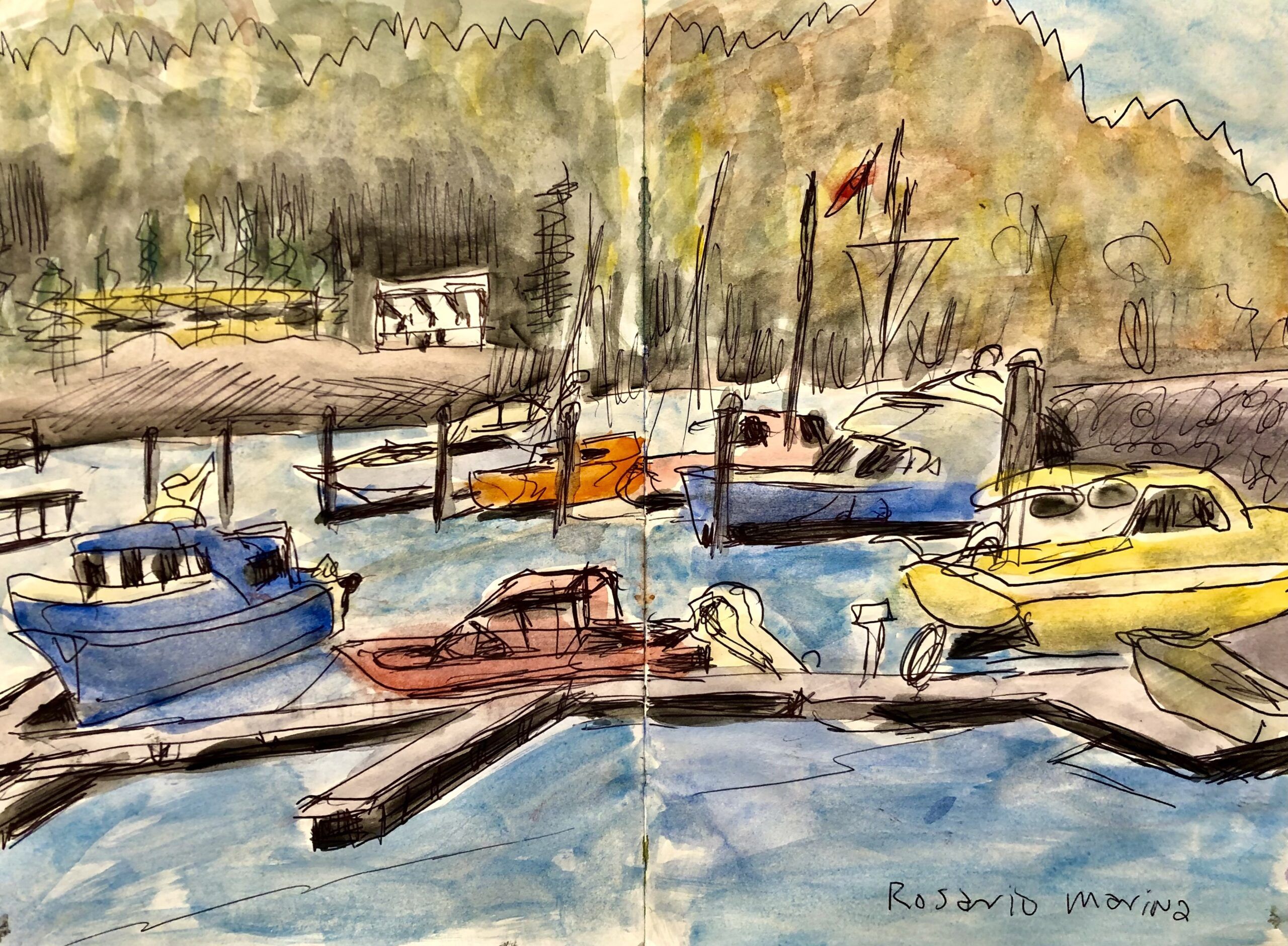
Heinz squinted southward through the haze across the water. Jagged mountaintops stood silhouetted in the distance, maybe a dozen kilometers away.
So that’s what Switzerland looks like.
He’d known since he was a schoolboy that Switzerland was full of mountains, but he never thought he would have the opportunity to actually see them for himself, much less walk among them. The peaks stood much larger and higher than he had imagined. Books and magazines hadn’t done justice to the vista. He’d wanted to see and touch these mountains since he first saw them depicted in an encyclopedia at the library when he was a boy. His hand went to his breast pocket to touch the ferry ticket.
He had come a long way in his seventy-five years to this spring morning in 2011. The walk from the rail station in Friedrichshafen to the waterfront of Lake Constance, der Bodensee, took less than ten minutes, and the exercise kept him warm in the spring morning’s chilly air. The last of the snow had finally melted around this part of the country as May progressed. Back home in Erfurt, the shady spots still harbored crusty remnants of last winter’s snow.
This trip of a lifetime almost didn’t happen. Heinz’s son had picked up the telephone and made the reservations for the ferry and a hotel room in Rapperswil on the eastern edge of Lake Zurich. “There, Dad. You have a ride and a room reserved. After wishing for so many years, you’re going to Switzerland.”
Heinz stepped onto the terrace of the Gastätte Bodensee cafe on the Uferpromenade, the wide walking space on the north shore of the lake. Green umbrellas stood over the ten tables on the terrace, and six people sat outside, taking in a late breakfast and reading newspapers. At one table a lone woman with gray hair sat at a small table near the railing. The aroma of coffee mixed with the sound of clinking flatware floated in the air, and Heinz took a seat at an empty table near the railing, where he could see more of the lake. The enameled wrought iron chair felt chilly. A white tablecloth with placemats covered the iron table, and the fabric rippled in the faint breeze that carried the scent of the lake. He slid his suitcase, not much more than an overnight bag, under the table. He had never needed much, and on the rare occasions for travel, he always traveled light.
Heinz had made an early start this morning, his son seeing him off at the rail station in Biberach, and the ride through Ravensburg, arriving in Friedrichshafen. All told, the trip took less than an hour. Georg was right. After journeying some 350 kilometers southwest from Erfurt to Biberach, why not take the trip to the border? Georg had known of his dreams of Switzerland for years. His son had never visited the lake nor crossed the border, despite living this close for years.
Heinz thought of Alexei, the man who had occupied the bench next to his all of those years in the optical works, grinding and polishing lenses and prisms. They were friends, not close like brothers, yet still friends who took the occasional beer or coffee together. Almost the same age, Alexei came into the world three months after Heinz, and he departed this world a scant two months ago, collapsing from a heart attack after climbing aboard a streetcar. Heinz had been one of less than a half dozen who attended the funeral. The notion that the end could be nearing for him as well had reawakened old thoughts of Switzerland.
A waitress stepped up to the table. Heinz greeted her with a smile and ordered a kännchen of coffee with a kaiser roll. He had already eaten breakfast, but the soft boiled egg and cheese at his son’s house had long since digested.
The waitress brought Heinz his coffee and roll. She paused after pouring his first cup from the small kännchen pot. “Anything else, sir?”
“No thank you.” Heinz shook his head. “This is good.”
The waitress nodded with a smile and turned away. The lone woman rose from the nearby table, coffee cup and saucer in her hand, and she stepped into the space where the waitress had stood.
“Excuse me, may I join you?”
Heinz pulled the adjacent chair out for her and gestured to it. “Please.” After spending a week with Georg’s family, he knew that he spent too much time alone.
Her pewter-colored hair moved with the weak breeze. A barrette kept it clamped to a ponytail that fell just below the shoulders of her pale green jacket. The lines in her face told Heinz that she had to be at least in her sixties. The years had gracefully settled on her slim frame, and she must be one of those who stayed active. Heinz always walked twice a day and harbored a secret pride that he still wore the same size clothes since his thirties.
“I couldn’t help but notice your accent.” The woman’s face pinkened as she settled into the chair, perching like a bird ready to take flight. She set her cup down on the table. “My dead husband came from Berlin.” She spoke the dialect of this region, Swabian, but likely watered it down for Heinz’s benefit.
Heinz smiled at her. He had hardly exchanged six words with anybody since stepping off the train, and it was good to have company. Back in Erfurt, he experienced days without conversation, and often the silence was too much to bear. “I imagine he talked too loud.” He winked and sipped coffee. “All Berliners talk too loud.”
She chuckled. “Even his last words.”
“I’m sorry for your loss.” He set his cup down.
“Thank you. It’s been several years.” She pressed her hands into her lap. “Where are you from?”
“Breslau.”
Her eyes widened as if she had seen a ghost. “You’re Silesian.”
Heinz nodded, flattered that she recognized his birthplace. He didn’t know why he revealed that when he had spent the last sixty-five years in Erfurt. Silesia, like West Prussia, Pomerania, and East Prussia all vanished in 1945. Breslau took on the name Wroclaw as those territories became the western portion of today’s Poland. The Russians and the Poles had enforced the takeover in 1945 with heavy handed vengeance. Heinz’s family had twenty minutes notice to pack their bags and leave.
“Actually I’ve spent most of my life in Erfurt.” He sipped coffee. “It’s where the Russians resettled my family.”
“Of course.” She nodded, her voice quiet and her eyes examining.
He extended his right hand. “Heinz Maurer.”
She shook his hand. “Susanne Klein. What brings you here, so far from home?”
Heinz pointed a finger toward the lake and mountains looming behind the southern shore. “That.”
She followed his finger to peer across the water and frowned, not fully understanding.
“Switzerland.” He lowered his hand. “I’ve never seen it. After all those years living in the East, Switzerland seemed more of an idea than a real place.” He turned to look at her. “I was visiting my son in Biberach, and with the border so close, why not?”
Susanne nodded. “We see a lot of Swiss coming into Friedrichshafen these days. With the franc exchanging so high against the Euro, everybody does their shopping here. They’re very friendly, and of course the merchants love to see them.”
“Now that I’ve seen Switzerland. I can go now.” He nodded at the lake and began to rise from his seat.
“What?” Her eyes widened.
“I’m kidding.” Heinz settled into his chair and patted his breast pocket. “I bought ferry tickets to go over today.” He picked up the kaiser roll that came with his coffee and tore it in half. He offered a piece to her. “Help me eat this. I have a tight schedule.” The brochure in his bag listed the departure times, ferries departing each hour, and he wanted to take the first boat over. His son Georg was right to force the issue, and like Alexei, Heinz didn’t know when the end would come. Take the opportunity now to fulfill an old dream.
“Thank you.” She took the bread and nibbled at it.
Heinz dunked the corner of his piece in his coffee and bit off a piece as he watched the far shore of the lake. During all of those years in the East, the rules, the Party, Heinz had fantasized of taking Georg and escaping to Switzerland. In Switzerland, a man could live free and do as he pleased.
He pointed across the lake. “This view reminds me of another when I was a boy, when Dad would take us to the Baltic on vacation. We’d stare across the estuary at Travemünde, at the West.” Heinz dropped his hand to the table and gazed across the lake.
Susanne joined him, looking at Switzerland. “I’ve never seen the Baltic.”
“You’re not missing much. Acres and acres of mud flats, and the wind is so cold.” He looked at her. “My son tells me that it gets pretty warm around here in the summer.”
She nodded. “But the lake is still icy, even in August. You’ll have to come back and see for yourself.”
Heinz weighed the logistics of a return trip. Everything was more expensive in the West. He’d been frugal with his pension, and it kept him comfortable in Erfurt. Maybe he had been too comfortable and had forgotten his old dreams.
“You son lives in Biberach?” She put a hand on his arm.
“Yes.” He nodded and smiled, stealing a glance at her hand. Its weight and warmth made him feel good, wanted. Heinz couldn’t remember the last time he experienced a friendly touch. He edged closer to her, but not so close as to scare her away. “A very charming town, very clean, and very Catholic.”
Susanne tilted her head, much the way a dog will when encountering something unusual.
“We never went to church much in the old days, not exactly encouraged by the Party.” He shrugged. “The few times we went: Christmas and Easter, we went to the Lutheran church.”
“Being Silesian.”
“And living in Erfurt.” Heinz shrugged again. “Georg and his wife showed me the church in Biberach. It’s in the middle of the town square.” He turned to face Susanne. “On the outside, it looks rather drab, weatherbeaten dark stone, maybe a couple of gargoyles, almost boring.” He held up a finger. “But once you get inside – wow. The stained glass windows, and all the gilded statues, and the frescoes on the wall. You’d think it was a Roman basilica or something.” He nodded and reached for his coffee. “Sure impressed me.” He set his cup down. “I never saw churches like that in the East, and I didn’t know what to think when Georg and Uta told me that they had joined. That was right before they took me to Sunday mass.”
A smile creased Susanne’s cheeks, and he liked the way her smile reached her eyes. “And you didn’t know when you were supposed to stand, sit, or kneel.” She sipped her coffee.
“Good thing my son wanted me to feel welcome.” Heinz nodded. “He kept telling me what to do and when.”
“I visited a Catholic mass with a girlfriend once.” Susanne set her coffee cup down. “I almost died of embarrassment, standing when everybody else kneeled and not knowing what to do with my hands with the – ” She searched for the word.
“Genuflecting?” Heinz reached for the coffee kännchen pot.
“Yes, that’s it.” Her eyes brightened in recognition.
“I was never comfortable with ceremony, and my daughter in-law has pictures of Pope Benedict hanging in the living room and kitchen.” He nodded. “Gives me the creeps.”
“Why?” Susanne’s eyebrows rose.
“Reminds me too much of the old days, when people always had portraits of the Party Chairman in their houses and everywhere: Ulbrecht, then Hohnecker. Even Krushchev and Brezhnev.” He rolled his eyes. “At least the pictures of Stalin came down in a hurry.”
“I guess you don’t hang any pictures on your walls at home?” She patted his arm.
“Just my son and his family.” His arm tingled pleasantly where her hand had been. “Here, take a warm-up.” He poured coffee into her cup.
“Leave some for yourself.” Her eyes met his. “It’s your kännchen.”
Heinz emptied the kännchen into his cup and set it down. “There. Lord knows, coffee is cheap enough, and I can order more.” He looked again across the lake.
“Why is Switzerland so important to you?” She sipped coffee and waited for him to answer.
“Switzerland is freedom. A place where a man could be what he wanted, where he could do and say as he wished without having to worry about the Stasi.” Heinz looked down into his coffee cup.
“You had run-ins with the Stasi?” She watched him and waited to catch his eye.
“Not like you think.” He shook his head. “I remember going to the market, and for the third week in a row, they still had no eggs. I remembered griping about how the latest Five Year Plan didn’t seem to cover having enough goddamn eggs for breakfast. That’s when I felt a hand on my shoulder.” He also remembered the man in the adjacent apartment disappearing in the middle of the night. The wife and two children left behind scurried furtively in and out to work, to school, and to the market, like mice running along the baseboards, until they disappeared a week later.
“You were arrested?”
“No, nothing as serious as that.” He waved her words away. “A man dressed a lot better than me told me to shut my stinking mouth if I knew what was good for me.”
“Stasi?”
Heinz shrugged. “Maybe. At least a Party member. Either way, he was waiting in the same line as me for eggs that weren’t there. I had enough sense to shut up, not let my mouth put me in jail. I had a son to raise.” He sipped coffee. “I believed that the people in Switzerland never had to wait in line for eggs. They could get them anytime they wanted.” Now that his son was raised and doing very well, what would Heinz do next? When there’s nobody left to take care of, is it freedom or uselessness?
She nodded. “Erhard told me that it was always hard to find ordinary things at the market.”
Heinz chuckled. “We were always short of something or another. If it wasn’t eggs, it was something else.” He smiled at her. “I imagine your husband had some tales to tell you.”
She smiled back. “There was the year of the shoes.”
“Ah, the shoes.” He smiled at the familiar story.
“You know?” She tilted her head.
“You tell me the story as your husband told you.” Heinz leaned back in his chair.
“The stores had an abundance of shoes, more than anybody could wear, but no meat or butter.” She shrugged. “Erhard said that if he could figure out a way to eat shoes, he would have bought plenty.”
Heinz nodded and remembered. Things were so very different in the old days. He lived through the year of the shoes that she described, as well as the season of no eggs, no meat, the time of too many shirts and no flour in the stores. Now, he could buy anything he wanted, or things he never wanted, because the stores now had plenty. He rested his chin in his hand and glanced at Switzerland from across the water. Things had changed quite a lot since his younger days, when he and Charlotte first married and moved into the apartment. Soon enough, she had grown dissatisfied with the shortages at the markets, then later, dissatisfied with Heinz and his station in life.
“Penny for your thoughts.” She touched his shoulder, fingers leaving a warm impression that he wanted more of.
“Wondering about my ex-wife.” He turned to face her and shook his head. “She ridiculed me for liking Switzerland and called me a fool.” He grasped his chin. “Over forty years ago. The officer and party member she left me for must have found himself very suddenly unemployed with the reunification.” He grinned. “Cosmic justice, I guess. She wanted to ride the man’s coattails to the top, and as I remember, a lot of those party muckety-mucks ended up driving cabs and running newspaper kiosks for a living.”
“My Erhard thought they all should have gone to jail instead.” Susanne finished her coffee. “He escaped to the West in 1964.”
Heinz felt impressed. “How did he get out?”
“A tunnel. They had several in those days. One of the first things he did after escaping to the West was enlisting in the Bundeswehr. That’s how we met.”
“You were in Berlin?” Heinz knit his brow, trying to follow her story.
“No, no.” She waved her hands. “I need to get things in order. He enlisted in the Bundeswehr, and they sent him to Sigmaringen for training.” She gestured to the north with her left hand. “I grew up there, and that’s where we met.”
“How did you end up in Friedrichshafen?” Heinz rested his chin on his hand and watched her face. Her blue eyes seemed to reflect the color of the lake, and he liked that. He knew that the ferry would be leaving soon, and he should hurry. This woman didn’t talk or carry herself like the housewives and widows in his old neighborhood, and he wanted to learn more about her. She held herself straight and tall, her smiling face and ruddy skin radiated sunny optimism instead of complaining, and he wanted to hear more of what she had to say. He could catch a ride on the ferry’s second departure, and it ran every hour. His tickets were good for all day.
“Erhard liked being near water, and after he retired from the Army, we settled here.”
“A wise choice.” Heinz looked up and down the waterfront. A forest of masts and sails rose from a nearby marina, and more people walked the sidewalks and promenade as the sun warmed the air. “I spent my Army days guarding the border.” He rolled his eyes. “A colossal waste of time.”
“Which border?”
“The NVA posted me and half my school friends straight south of Erfurt. We spent most of our duty time admiring the trees in Bavaria.”
“You didn’t have anybody try to escape to the West in your sector?” She touched his arm.
He patted her hand and wanted her to keep it there. “Thank God no.” Not when he was on duty. “Our sector was very wide open and not very tempting. We’d have arguments in the barracks when we were off duty, about being able to shoot fellow Germans if the West attacked. I’m not sure I could, although as a soldier, it would have been my duty. Shooting German civilians…” He shook his head. “I couldn’t do that, and I wasn’t the only one who felt that way.” He smiled. “But we could tell from those arguments in the barracks who was going to be a Party member and get promoted to sergeant.”
Heinz remembered the one morning when the sergeant had ordered him and two others to remove a body from the wire, and he decided to keep this story to himself. Two men had tried to escape in the hours before dawn. After the guards had shot the one with the wire cutters, the other surrendered. The captain decided to wait until daylight to remove the corpse.
“I’m so glad those Cold War days are gone.” She squeezed his arm. “Aren’t you?”
“It’s been twenty years, and most days I’ve completely forgotten. On the train out of Erfurt, you can’t see any signs of the old border between Thüringen and Bavaria any more. I spent two years out there, guarding that border, and now it’s all gone.” He grinned. “If it weren’t for old guys like me remembering, it’s almost as if it never happened.” He thought back to pulling the body off of the barbed wire, the gaping exit wounds in the dead man’s chest. It did happen, and old guys like him couldn’t forget, even when they wanted to.
“My Erhard used to say the same kinds of things. You would have liked him.” Susanne settled back into her chair.
Heinz signaled the waitress, then turned to Susanne. “I would have liked to have bought him a beer and talk about the old days. Instead, I’ll buy his widow a coffee.”
The waitress stepped to the table. “Yes?”
“More coffee, please,” Heinz said. “Have you any pretzels?”
“Oh, yes. The bakery sent plenty this morning.” She gathered up the empty coffee cups.
“Excellent. We’ll take two.”
The waitress nodded and left.
“You don’t have to buy me anything.” Susanne’s cheeks creased.
Heinz liked the way the laugh lines deepened in her face when she smiled. “It’s my treat. The coffee here is very good, a lot better than my daughter in-law’s.” He winked. A motorboat crossed the lake from right to left as he looked at the water. The buzz of its engine faded as the boat grew distant. “I like it here.”
“Where are you going to visit in Switzerland?”
Heinz rested his chin on his hand. “I’m not completely sure. I thought I’d see St Gallen, because it’s not too far, likely Zurich. It depends on how far my money takes me.”
“Zurich is just another big city. I’d suggest you try the smaller towns along the lake.”
“You’ve been there?” He looked her in the eye.
“Of course. It’s just a ferry ride away.” She held out her hands. “I’ve visited plenty of times.”
He took her right hand in his. “Then advise me, Frau Klein, where should I go?” Her fingers felt warm against his palm, alive and comfortable.
She glanced at their intertwined hands, then met his eyes. “First of all, Heinz, call me Sanna.” She addressed him in the familiar, her voice soft and low. “I’m, Frau Klein only to the kids in the neighborhood.”
“Done.” He squeezed her hand. “I’m a lot older than those kids and ought to know better.” He felt her hand squeeze back and not let go. The warmth of her skin against his brought a sense of comfort that he hadn’t had since raising Georg and before times grew bad with Lotte.
The waitress returned with another kännchen of coffee, two cups, and two soft pretzels. Heinz pulled out his wallet and paid the bill, rounding up the sum to the nearest Euro as a tip.
“You’re the first person I’ve seen who takes pretzels with coffee.” She lifted a pretzel and sniffed. “They smell good.”
“Blame it on the Mangelstaat. Heinz took his pretzel and bit off a chunk. He washed it down with coffee. “We never had enough sugar or fresh fruit for sweet pastries, so I learned to make do.” He eyed the morning sun’s position. “And it’s still too early for a beer.”
Susanne sipped coffee. “I like the combination.” She paused to glance at the pretzel in her hand, then looked him in the eye. “It’s different, the saltiness and the coffee. I’m not sure how to describe the flavor.”
“Tastes like breakfast in Erfurt.” Heinz tore another piece off of his pretzel and chewed. “Back in the day.” The too-large chunk of pretzel had formed a starchy lump in his mouth, just like in Erfurt. Heinz worked at it with his tongue, hoping to not dislodge his upper dentures. He hated it when that happened, but back then, it was the best he could do for breakfast. He hated himself in the moment for ordering such foolishness when he knew he could eat better in the West, and making a fool of himself in front of this charming woman. Those days were long gone, and it was plain foolishness to visit those miserly times. Heinz willed a smile to his face, not wanting to break the spell he and Sanna had, and washed the starchy lump down with a gulp of coffee.
“What’s it like in Erfurt?” she asked. “I’ve never been in the East, no closer than a trip to West Berlin back in the 80s.”
Heinz shrugged. “It’s just an old town with a lot of old folks like me living there.” He ran a quick inventory of his neighbors through his mind. The youngest was in his fifties.
“No children?” She cocked an eyebrow.
“Of course there’s children there, just not as many as before, so it seems.” Heinz shrugged, thinking. It had been a long time since he last saw children playing on the sidewalk, and those were a neighbor’s grandchildren on a visit for the holidays. “A lot of the younger people moved to the West, like my son Georg.” he nodded at her. “Better work, a chance at a better future.”
“Naturally. Who wouldn’t want to make a better life for his children?” She tore a piece off her pretzel and chewed.
“And how many children do you have?” Heinz raised his coffee cup to his lips.
“Two daughters. Ulrike lives in Sigmaringen with her husband Harold, and Liesl is in Stuttgart.”
“Grandchildren?” He took a second sip of coffee.
“Just one, Ulrike and Harold’s son. Thomas will turn ten this summer.” She sipped coffee. “And you?”
“Two. Gaby and Toby, and they’re both teenagers.” He rolled his eyes. “Just you wait until Thomas reaches thirteen.”
She chuckled. “Can’t be any worse than when our kids were teenagers.”
“The teenagers in Switzerland are much better behaved.” He sipped coffee and looked at her. “Got to be.”
“Oh?” Her cheeks dimpled and wrinkled again as she smiled.
“Of course. Everything’s better in Switzerland.” He looked across the lake. “After sixty-five years in that shithole in the East, Switzerland looks very good.”
She pulled back, as if she had been slapped.
“I’m sorry.” He put his hand on her knee and shook his head. It had been a long time since he last felt happy or satisfied with retirement in Erfurt, and the long pent-up words had simply spilled from his mouth. He liked this woman and didn’t want to burden her with his troubles. “Erfurt’s a dying town. Nobody but us old timers left, and what we remember isn’t always happy.”
She took his hand. “We all have regrets, things we could have done better, if we’d only known.”
He squeezed her hand. “Thank you for understanding.” Being a widow, she must have experienced plenty of her own troubles.
She reached out with her free hand to touch his cheek. “You must have had it very hard in the East.”
“Hard enough.” It had been decades since the last time a woman touched his face. It felt good and reminded him just how alive he was. After Lotte left, he spent his time raising Georg and working. Somehow, that had never left any room for dating or a social life beyond commiserating with the other parents in the neighborhood. “I’m glad to be a free man.” He patted his pocket, where the ferry ticket lay. “I can cross the border any time I want.” He wanted to get on the ferry, but he didn’t want to lose this moment with Sanna.
“And you won’t need a tunnel like my Erhard.” She offered a smile.
“But I’ll still need my passport.” He smiled back. I’ve heard that the Swiss are very orderly.
“And they won’t ask to see it, because the Swiss are very friendly.” She squeezed his hand. “You’ll have a grand time seeing the sights.”
He nodded agreement and considered inviting her to join him. But they had just met. He wanted to know her better and wasn’t sure how to accomplish that.
“And this is something you’ve wanted to do for a long time, so enjoy yourself. Tell your son what he’s been missing.” She shook her head. “Living all those years in Biberach and never once heading down this way.” She clucked her tongue.
Heinz finished his coffee. “I think I missed the first boat.”
She glanced at her watch. “The next ferry leaves in an hour. Did you exchange your Euros for francs?”
“Naw.” He shook his head. “I thought I’d do that after crossing the border.
“Let me take you to my bank. The exchange rate there is better than what you’d get over the border. They see the tourists coming and just fleece them.”
Heinz reached for his bag and rose. “I’m lucky to have this expert advice from a local.”
Sanna waved his words away. “You’re a thrifty man who appreciates a good bargain. You didn’t work all those years just to throw your money away.” She took his arm and nodded to Friedrichstrasse.
Heinz stood a little taller than usual as she led him past the rail station and north on Riedleparkstrasse toward her bank. Lotte once took his arm like this when they walked, but that didn’t last long. Sanna had a subtle way of showing when to turn and which way to go, not towing or steering him like a schoolboy, and he liked that. The last time he walked the city with a good woman on his arm, he was a just a young man.
He wondered what made Sanna so interested in him and eager to help. The attention felt flattering. After all those years taking care of his son and himself, somebody was extending a hand to help him. This woman may have been a stranger to him a half hour ago, but he realized that now she may have become his friend. He wanted to know more about her and what she liked.
Sanna chatted about Erfurt and the East, asking more questions about his neighborhood and what sights the city offered.
“It’s just the place where I live.” He shrugged.
“But as I’ve said, I’ve never visited the East. Erhard had no desire to travel there after reunification, and I’ve always been curious.
“A lot of old buildings.” He shook his head.
“And Switzerland has a lot of old mountains. It’s a matter of perspective.” She looked at him.
“You want to see what you’ve never seen before.” He shrugged.
“Isn’t that what you want to do with visiting Switzerland?”
“Yes.” He nodded and looked her in the eye. “I just can’t imagine anybody wanting to visit Erfurt to see the sights.”
“Surely, the downtown has its share of historical places.”
“I suppose so.” Heinz thought of the old Rathaus, the original town square by the river, where the farmer’s market was set up every Saturday. A lot of that escaped the bombing during the war, and there was the big church, where he took Georg on Christmas Eve and Easter Sunday. The same church where Martin Luther once preached and talked of reformation. She didn’t need to see the boxy concrete apartment buildings that went up in the 1960s.
They soon reached her bank, and the exchange rate was better then what Heinz had anticipated. After changing his Euros for Swiss francs, he thanked her for the tip as they returned to the waterfront and the ferry terminal.
The large ship was already docked and taking cars and passengers for the trip across the lake. Its diesel engines idled a baritone rumble.
“Here you are.” She patted his arm. “From here, your next stop is Romanshorn, gateway to Switzerland.”
Heinz looked at the large ferry, painted white with a red stripe along the gunwale. “After all these years.”
Sanna reached into her purse to pull out a pen and a scrap of paper. She jotted on the paper and pressed it into his hand. “Call me when you get back. I’d like to show you the Zeppelin Museum before you go home to the East.”
“Zeppelin Museum?” His eyebrows rose. He had never heard of such a place.
“The airships, of course.” She pointed to the white building next to the ferry landing. “And it’s right here.” Sanna put her hands on her hips. “This is Count Zeppelin’s hometown, and he made all kinds of test flights over the lake.”
Heinz stopped to think of the giant dirigibles associated with Zeppelin, stories his father told him when he was a boy. The Germans built the biggest and the best. Everybody remembered what happened with Airship LZ-129, the Hindenburg, and that marked the end of the era.
The horn on the ferry blew to warn that it would soon be departing. Heinz looked up at the boat’s bridge. He pocketed the paper slip. “I’d enjoy seeing the museum. Thank you.”
“Now get on the boat, or you’ll miss Switzerland.” She nudged him toward the ferry. “You’ll have a home cooked supper waiting for you when you get back.”
Heinz boarded the ferry and headed to an upper deck, where he could see the lake and the dock. He returned Sanna’s wave as the ship pulled away and headed south across the lake.
White foam trailed the ferry as it turned to depart the harbor, then picked up speed and the people on the dock shrank to dots on the horizon. Heinz continued waving until he could no longer see her. His hand went to his pocket and his fingers rubbed the slip of paper with her phone number. He looked over his shoulder and glanced at the mountains of Switzerland.
Heinz kept his gaze to the north and the woman he had just met long after he couldn’t make out her form or the docks.
Mom’s Friend Roxanne
There is someone in my house who is not my mom. She looks like her. She smells a little like her. She likes the same jazz music as her. But she has it turned up too loud, and she’s naked. She dances around the foyer like leaves in the wind, and I want to show my mom this crazy woman, but I can’t find her.
I run to my room to get my camera, the one I got for Christmas. You have to wind back with your thumb until you hear a click, then you take your picture. I snap a photo and wait for the print. A few minutes later, the image of the crazy lady is finally complete. Her messy, sweaty hair is all over her face. Her skin is pinker than my mother’s.
I look everywhere for Mom, but she’s gone. The dancing woman must be my babysitter. I sneak past her into the kitchen and have ice cream even though it will spoil my dinner. But dinner never comes. When I wake up the next morning, I realize I fell asleep with my ice cream bowl in my bed. The melted cream dried crusty on my sheets.
“Hi, sweetie,” Mom says when I come downstairs for breakfast. The kitchen smells sweet. Mom looks pretty. Her hair is curled, and she has lipstick on. She has on dad’s old robe that she’s always wearing since he went to jail. “I made chocolate chip pancakes for breakfast. Do you want one or two?”
“Two, please.” Chocolate chip pancakes are my favorite. Mom doesn’t make them a lot, because too much sugar is bad for you. She plops two fluffy ones on my plate with a smile, and I smile back. She doesn’t mention that I finished all the ice cream.
We sit at the kitchen table, sitting opposite each other. I pour syrup over my pancakes, and a lot more comes out than I’m allowed to have. I look to see if mom noticed, but she’s drinking her coffee, staring at the wall.
“Mom.”
She jumps like I scared her. “Yes, sweetie?”
“I saw this crazy lady yesterday.”
“Where, outside?”
“No, in the foyer.”
I take my photo out of the pocket of my dinosaur robe and slide it across the table. Mom’s eyes widen, and she gasps, putting her hand over her mouth. She stares at the photo for a really long time. I wait for her to laugh, but by the time I finish my pancakes, she’s still staring. Finally, she clears her throat and gives me a smile that lasts less than a second.
“Get dressed, and I’ll drop you off to school, baby.”
It’s definitely a good day, because I normally walk to school. Dad used to drive me, but then he went to jail. Mom does a good job driving, too.
Mom talks on the phone while we drive. I sit in the backseat and look out the window. I see her look at me in the mirror, but I pretend I don’t see. She hates it when I listen to her conversations. It’s “nosy.”
“Caleb saw Roxanne last night,” she says, hushed. It’s hard to hear her over the sound of the radio. “A picture…Christmas camera…no. I swear! Yes… Well, I’m alone, y’know… mhm. I hear you. Yeah… who wouldn’t be? This is not why I called you!” she says louder. I think she says a curse word. She puts her phone down and turns the radio up.
Mom must be mad because she had to fire Roxanne. I’m sad Mom is upset, but I’m happy she’s leaving. So, I’m surprised when two days later, Roxanne is in the kitchen.
Music is playing again, too loud. I can’t concentrate on my homework. Roxanne is wearing one of my dad’s old jerseys and a pair of shorts I think are mine. She sways her hips back and forth while she stirs a boiling pot. The music has no words, and she’s singing in a language I can’t understand.
She sways and sways and sways till she’s facing me. Her face is puffy and red like she’s been crying, but she looks very happy. She drops the ladle and reaches her hands out to me when she sees me. “Caleb!”
It’s too late for me to run, and she pulls me close to her hot, moist body. I wince as she plants damp, soggy kisses on my face, and I wipe them with my hand right away. Roxanne doesn’t notice. Roxanne doesn’t notice anything.
“You look just like your daddy with your face all pinched like that. Dinner will be ready soon!” she shouts over the loud music. I groan and go back to my room. I give up on my homework and watch TV instead. Mom will have to write my teacher a note. It’s her fault for getting me a horrible babysitter who doesn’t do homework with me.
I watch TV until my eyes hurt. I don’t know what time it is, but I know it’s past dinnertime. My stomach is cramping. The music downstairs has stopped, but Roxanne never called me down for dinner. Or maybe I just didn’t hear.
The air downstairs is hot, and it hurts to breathe. It stings my eyes the closer and closer I get to the kitchen. I trip over something I can’t see and fall to my knees. Why didn’t Roxanne turn on the lights when it got dark? My eyes water, and I scream for my mom until my throat hurts.
I must’ve fallen asleep, because I woke up in my mother’s arms. She’s crying and kissing all over me. “I’m so sorry,” she says over and over. “I thought I turned the stove off. I’m so sorry.”
Why are you sorry? I want to ask, but my throat feels like it’s full of sand. It hurts to open my mouth. I need water. I need to tell her about Roxanne.
“The fire department is here,” my mom whispers quickly, like she’s in a rush. “They’re coming in to check on the oven. Why don’t you go up to your room? If you’re quiet, I’ll bring you some cookies and milk. But you have to be very, very quiet.”
I need milk now, and I haven’t even had dinner yet, but I’m too tired to speak. It feels like I’m walking in slow motion. Each step makes my head drum. When I get to my bed, I’m out like a light.
When I wake up, I realize I overslept for school. My night table is empty. Mom never brought my cookies and milk. I bury myself deep into my blankets so she won’t hear me cry.
There are two good things about September. The entire second grade is doing a play at school at the end of the month. The Wizard of Oz. I practice lines and get the part of the lion. It’s a lot to remember, so I practice in the mirror every day. My teacher gives me notes on how to look more expressive.
The second good thing is that Dad’s birthday is in September. September 12th. But I guess because he’s gone, we don’t do anything special on that day anymore. We can’t even call him because Mom said he lost his “privileges.” So, she just sleeps. She always sleeps. Every time I need something, she’s sleeping. It’s very annoying. Sometimes my dinner is left wrapped in foil on the kitchen table with a note. Sometimes there’s no dinner at all. On those days, I make my own food. I make sandwiches, or cereal, or put frozen pizza in the microwave. I’m growing up, becoming a big kid.
Mom doesn’t pick out my outfits anymore, either, so I’m dressing myself now. I like that she’s letting me be a grown-up, but sometimes homework, cooking, and practicing for the play are too much. I got a detention for missing three assignments in a week. The house stinks. The garbage is piling up too much for the lid to fit on it. I don’t know how to use the mop, so the floors are dirty and sticky.
There’s always something to do. I get home and make my afterschool snack. I tidy up and throw out the empty bottles that have been appearing all over the living room. I shower (no more baths, I’m too old now, I’ve decided), and skip homework because I really am too tired. I lock myself in my room at 9 o’clock every night because that’s when the loud music starts. That’s when Roxanne is here.
But today I must go downstairs because it’s the play. Even with being so sleepy lately, I haven’t stopped practicing. I’m the best actor in the whole grade. One day I’ll be famous.
I walk downstairs around six pm. It’s quiet, but all the lights are on. I pause at the bottom of the steps, listening. There’s no music. There’s nothing but the sound of the refrigerator and this low humming.
I slowly walk to the kitchen and realize the humming is actually snoring coming from Roxanne, slumped over the kitchen table. Her hair is all crazy as usual. She smells like chemicals and pee.
I move a chunk of hair out of her face, and her eyes flutter open. “Hey, baby,” she says, her voice sounding like she has a bunch of marshmallows in her mouth. “What’s that?”
I step out of her reach before she can touch my homemade lion costume. I glued orange construction paper to a white shirt to make it, and it’s very fragile. “Where’s mom?” I ask.
Roxanne looks confused. “I am your mom, baby.”
“No, you’re not. You’re Roxanne.”
Roxanne throws her head back and laughs loudly. There’s drool crusted on her chin, and the bathrobe she’s wearing is filthy. Dad’s robe. The one mom almost never takes off. Roxanne grabs a glass from the kitchen table that’s filled to the top with a juice that smells both sweet and sour.
She lunges forward quickly, pulling me to her by my arm. I shriek as some of the juice jumps out of the cup, spilling all over the front of my shirt. “When mommy drinks her special mommy drink, Roxanne comes out,” she giggles, her hot breath tickling my face. “Don’tyoulike mommy like this? Don’tyoulike mommy happy?”
“Get off me!” I scream. Warm tears burst out of my eyes, spilling down my cheeks. I squirm and wiggle until she lets go. “You ruined my costume! I hate you!”
Roxanne gasps, and her skin gets very red, like she’s about to explode. “You ungrateful brat! You have no idea how much I do for you! With no help! You ungrateful little—”
She lunges towards me again, her eyes sharp and angry, as if she wants to hurt me. I jump out of the way, and she crashes to the ground, her glass shattering against the floor in a million sharp pieces.
“Caleb!” Roxanne roars. I run out of the kitchen and through the front door into the night. Tears pour down my face; I can barely see. I want mommy home now. I want things to go back to how they used to be.
I don’t stop running until I get to school. My teacher is waiting in the lobby with all the other kids in the play. “Caleb!” she says when she sees me. “What happened to your costume?”
I try to explain Roxanne, her temper, and how much I miss my mom, but all that comes out is more tears, so heavy I can’t speak. My lungs are pounding, and I can hardly breathe. “It’s okay, it’s okay,” my teacher says. “I’ll take you backstage. We have an old costume you can wear.”
She quickly takes me to the room behind the auditorium and gives me a lion costume to change into. It’s too big and smells like an attic. When I’m done, I see her smelling my spoiled costume, frowning.
“I’m all ready, Mrs.,” I say.
“What’s this on your costume, Caleb?”
“Special mommy juice. Roxanne spilled it on me.”
“Roxanne?”
“She’s my mom’s friend. She’s always at our house.”
She pinches her lips together and puts the costume in a plastic bag. For a second, she seems upset, but then she turns to me and smiles. “You look great, Caleb. Break a leg!” I know she doesn’t actually want me to break my leg; she just wants me to have good luck, which I need. I don’t feel like a lion at all tonight. I feel like a sad, scared kitten.
I line up onstage with my classmates. I hear the principal of the school talking, and then with a whoosh, the curtain lifts. Bright white lights shine on us like stars. The audience cheers loudly. I look into the crowd and see rows and rows of parents, pointing at their children, smiling, and taking pictures. There are video cameras with red lights, balloons, and signs. The auditorium is full of lots and lots of people, except for one empty seat.
Everyone onstage smiles, putting on what my teacher calls their stage face. Not me. I can’t smile. I can’t stop looking at the empty chair.
My mom isn’t here. Dad is gone. Not even Roxanne, who I can’t seem to get rid of, has come to see my play.
No one cheers for me in the audience. No one at all.
A Madness Shared By Two
The Week After Burial
Day 1. I’m cold.
Day 2. Waking and sleeping. Medicine. Sleep like death. Not close enough. I wonder things. Where did you leave the spare set of keys? I never needed to know this before.
Day 3. They keep bringing food, I keep saying “Thanks,” even though I know by 3 AM the lasagna will be vomit and toilet water swirling down down down the pipes and my throat will
burn.
Day 4. What was the last thing you saw? Was I the life that flashed in front of your eyes?
Are you here now, are you anywhere now, did you love me through the worst of it, and if I could say one last thing to you, have one last moment of truth from you, would I ask you if you fucked Amy from accounting?
Day 5. Your brother wants the X-Files collection. You hate your brother. He cried at the funeral though and anyway, I guess you can’t hate him now. Only past tense for you. “Hated” resolves it. He can have it.
Day 6. The room smells like decomposition. It makes me feel closer to you. What would you regret if you were here to do it? You have to tell me because you’re dead and dead things can’t lie. I don’t make the rules.
Day 7. Laughter. Cruel and unusual. I must be angry now. More medicine. Sleep like death. Closer. Time always passes.
Some Months Later, In Little Bursts of Time
Sometimes I hear your voice from the other room. I know that sounds crazy. Isn’t that a funny phrase? “I know that sounds crazy.” As if I need to justify myself to you, the one who makes me crazy by talking to me from the kitchen, three months from when your mother refused to meet my eyes after they lowered you into the ground. Anyway, when that happens it scares me, so please stop. When I’m ready, I’ll come to you. I remember our promise.
___________________
Couples holding hands feel like a personal affront. How could they not know? I pass a pair of them on the sidewalk before turning into the pizza place you didn’t like. A man with dark curly hair hands me the one-piece-of-pizza-heavy paper plate. He’s good-looking, like Brando in a dirty t-shirt good-looking. I hate him. My stomach churns with self-disgust. I sit in one of three empty booths and let the cheese burn the roof of my mouth, the hot bite landing in my gut like a rock. I can’t help it, I glance back toward Marlon, whose attention is on his phone. Probably in deep conversation with some starlet lost in the wrong decade.
He might have thought I was pretty once. Now I might as well be a ghost.
_____________________
I’ve walked past the gate a hundred times now. The first time was terrible. It’s bleak- the rusted metal, the screech I’m sure it would make if I pried it open. It took me weeks to go back again after that. Weeks of rotting in our bed that became my bed that I wish was yours instead.
These days I circle the block for hours at a time, always coming back to the gate, pausing and gazing my female gaze beyond the bars. There’s nothing there. Not yet. Sometimes I get stuck in time, pacing back-and-forth-and-back-and-forth-and-back-and-forth. My behavior might elicit strange looks if this were a different part of town.
Tonight I finally touch the gate – let my fingers slip through and feel the air on the other side.
I’m scared of you. Do you know that?
____________________
My phone has been dead for awhile now. No more messages. It’s peaceful this way, though it crossed my mind once that I must be jobless by now. That’s funny. I still answer to knocks at the door, for concerned family with well-wishes, to keep them at bay. They mostly mind their business. I think they perceive me as Grief and Grief should be left alone. Fine by me. There are no knocks tonight, and I don’t expect any. I hear the sound of you running the shower but you’re not and you haven’t and you won’t. Yet… laying in bed, I smell your just-washed skin. I almost feel the heat from your body next to me. The feeling surrounds me, petrifies me, convinces me. Yes, okay.
The room is awash in blue-gray twilight. It’s that time of the day when there is no fear of death because the heaviness of life is unbearable. My body feels like it’s trapped underwater but I move anyway. This time at least. I’m on my hands and knees scouring the floor under the bed. Well, it’s here somewhere. We should have cleaned this out before you died because I’ll never do it now.
There it is, against the far wall, just behind the twisted underwear leftover from a night you ripped them from my body. Or maybe they’re just from an overflowing pile of dirty laundry. I stretch my arms out fully under the bed, my ear pressed against my shoulder, reaching reaching, muscles pulling. Fingertips brush an old shoebox and I nudge it towards me.
I open it slowly as if I’m unsure of what’s inside, but I’m not. Just a little plastic bag of psychosis.
_______________________
My legs are heavy on this walk. The night is darker, as if the whole town has turned it’s eyes away out of respect. The thud thud of my feet on the sidewalk softens when I hit the grass in front of the gate. I can’t look up yet- I just can’t. Instead, I breathe in the familiar smell of rust, feel the give of the ground. A little autumn breeze touches my hair and some wind chimes somewhere. Deep breaths. Swallow.
I toss the empty plastic bag onto the ground and watch it dance away on the wind. It feels good to do a bad thing because, fuck, it doesn’t matter at all.
My fingers wrap around the bars, feeling the old flaky texture rub against my skin and I push. The gate gives against my weight and screeches in a tantrum. I slip inside.
In a sense, the garden is dying – the flowers planted by a loving hand are long withered, no one to tend to them, to keep them going, to pretend they have a purpose. But it’s also as alive as it ever was. Just not in a way that draws human visitors. Good riddance, really. The overgrowth and weeds, the insects who can survive and thrive are plenty alive. Even the rust that eats at the metal – what else can eat but something living? Death comes for everything – but it’s not death that has to stay here in the mess. What lives takes over what dies. What lives consumes it, covers it, eats it up, and survives from it. We forget the dead things. But not you. I won’t let it happen to you.
I walk towards the back of the garden where the darkness deepens, and my eyes adjust quickly -not much light in my life these days – to take in a bench with chipped paint, grass growing up around the legs, a silent observer of the cycle of life and death, not totally untouched itself. I feel afraid. That you’ll come, that you won’t. That I’ll never leave this dark place again, that I will.
Nevertheless – here I am. I’m making no moves, but I’m somehow in motion, toward the bench, where I sit and wait. Days, or hours, swirl around me. Colors and sounds mix and melt and fade, and my thoughts pass by until I think nothing, want nothing, feel nothing anymore. And then, there you are.
There you really are. Not a shadow or sound of you but your full form, wearing your favorite black sweatshirt and blue jeans, smiling at me, alive as I am. Which is to say, just barely. I keep my gaze straight ahead as you sit down next to me. The weight of the bench changes. You’re right here. You’re right fucking here. My breath quickens and my heart speeds up. I clench and unclench my hands as my palms become clammy. So much life coursing through me- I don’t like this, I don’t know what to do, what should I do? My entire body is reacting to yours, the way it did the first time we touched, but this is different. This might be wrong. I hear you sigh, and I know your eyes are on me, but I can’t look at you. If I look, we’re in this. Whatever this is, however you’re here.
Then I feel your thigh gently press against mine- that slight pressure of human touch that’s been missing for months. The little spot that warms while the rest of me stays cold. You don’t speak. I don’t think I could handle it if you did, so maybe it’s a relief. The lump in my throat is unbearable and I gasp out a noise like a cry. I don’t recognize the sound. As tears spill out I turn my head with effort, and look you in the eyes. They’re blurry behind the wetness in my own, but they are there and they are yours and they are drunk with love for me.
___________________
I’ve come back every night for weeks, expecting each time for this to be a mirage, but it never is. You’re always here. The street outside the gate is gaining it’s own little garden of plastic bags. I imagine this veil between us is more intrusive than we want to believe. Often it’s raining as we sit together, and that’s when I most notice how my senses have transformed. My aliveness is a stinging reminder of our separation. I smell the grass, the rotting flowers. I taste the air on my tongue. You don’t seem to notice any of it at all.
Sometimes I reach out and let my fingers graze yours. Mine are freezing cold but yours are just there. You don’t notice this either. We haven’t spoken. Maybe you can’t. For me, there’s too much that words could break. Sometimes as I sit with you for these hours on end, my stomach rumbles- yours never does. Your body makes no sounds at all. I started bringing apples so I could sit with you longer. Maybe I hope you’ll ask for a bite. No, of course not.
What good is this reunion when you have no touch, no taste, no words? I can’t help but come back because despite it all, I know you’re there. You always see me and the look you give is always the same. Longing.
___________________
Tonight, my body feels strange as I leave my apartment, on my way to you. My limbs are almost concrete, I’m moving so slowly. I don’t remember the last time I’ve seen sunlight- I’ve become nocturnal. I grab a bruising apple and my magic bag.
This time as we sit together, I have a compulsion to lay my head on your shoulder. My muscles are tired enough that the fear of rejection- or worse- doesn’t stop me for once. The fabric of your sweatshirt is soft and almost warm. Your shoulder is solid. If you would only lean into me too, it might all feel so real. At least you don’t disappear, which relieves me of my worst fears. I close my eyes and take you in. Hours roll on and I don’t even notice the hunger this time. And then, to my surprise, I feel something light on the back of my head. It’s your fingers, and they’re running through my hair.
___________________
This is the last time I’ll see you. We both know this somehow, and so you reach out to me and hold my hand. My temptation to break the silence is unbearable but my sense of dread is unassailable. I’m so tired – my bones feel hollow, disappearing. Before I came here tonight, I looked in the mirror for the first time in ages, compelled by a strange need to confirm that I still exist, I guess. The knocks at the door ended awhile ago now. Everyone’s gotten the message and left me alone. That’s how it should be. But now that I’ve become the sort of person who’s only companion is the ghost of my dead lover, I have to wonder.
Turns out I’m still here, mostly. But my hair is falling out. My lips are dry and white, and you could drown in the deep dark circles under my eyes. Yet here we sit, and you’re still gazing at me with reverence and a glint of something else. Not love anymore. There’s a searchlight behind your eyes- something seeing past me. I understand. I know how it will go. Okay.
I lay back on your shoulder and let you touch me gently. Your breath comes in deep sweeping continuous motion, and I try to match the pattern. But my lungs burn and my own breath is made of quick and shallow bursts.
Here we are at the end. How do you feel? You’re feeling things now, I guess. What’s it like? I don’t remember.
Lifting my hand to my mouth is a herculean effort. I use every bit of energy left inside me, to bite my apple one last time. Not from hunger – that’s long been gone – but as a final confirmation. It’s ash in my mouth. I hand the fruit to you and you take it with ease. You touch your tongue to my bite. My vision is fading, but I hear your sharp intake of breath. I imagine the way your eyes must glow.
I wonder if you thought I wouldn’t notice when they stopped seeing me – when they only saw the tiny bit of life within me- that life that was so small, so diminishing. How did you find it at all? How did you know it was something to steal? Anyway, I did notice. I knew the game. It’s just that I agreed to play and lose a long time ago.
I sink down until I’m sprawled over your lap. Your body is warm, warm, warm. Your hands run up and down my back in a smooth sliding motion. You smell my hair, you kiss my head. As my limbs stiffen, everything turns to dust inside me. Returns to dust, returns. From dust you came, from dust you shall… But not you, my love. Not you. As you pull away from me, my body hits the hard bench and loses the warmth of yours, although I don’t notice it much. I see your silhouette as it walks toward the gate. It is the last beautiful thing I will ever see.
And you will live forever.